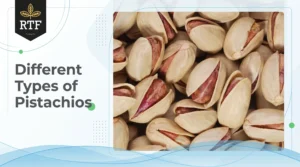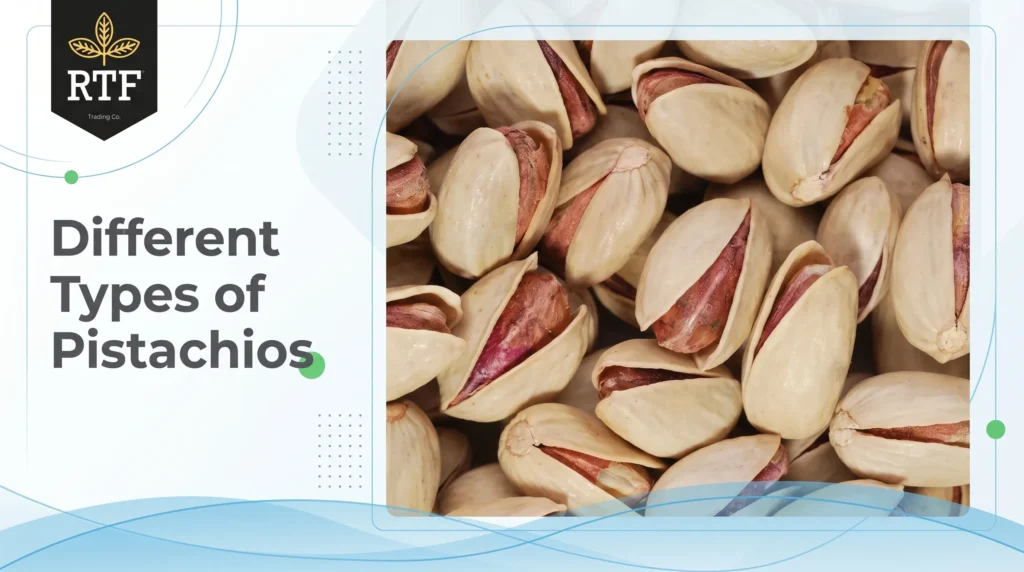
While these nuts might be similar in appearance, the differences become apparent very quickly. Some are long, some are round, and some varieties are noted for their large shells, green kernels, flavour and sure supply.
The different types of pistachios sold commercially are Kerman, Golden Hills, Lost Hills, Akbari, Ahmad Aghaei, Fandoghi, Kalleh Ghouchi, Siirt, Uzun, Aegina and Larnaka. Consumer similarities and differences are related to taste, appearance, and price. They also impact packaging, positioning and customer satisfaction for wholesalers, retailers, supermarkets and food businesses.
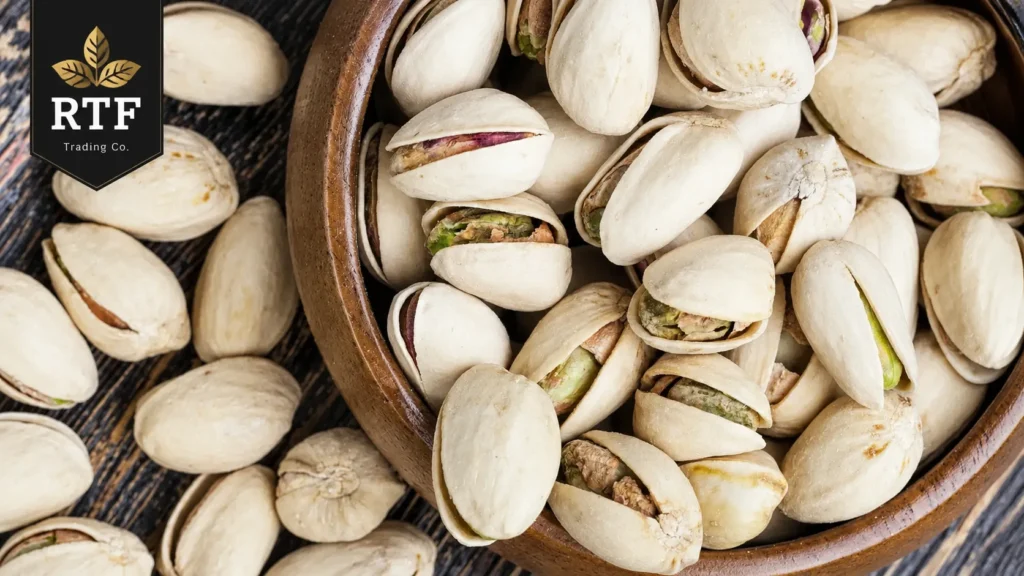
Quick Comparison of Popular Pistachio Varieties
| Pistachio Type | Main Origin | Typical Shape | Best Known For | Common Use |
| Kerman | United States | Medium to large | Established commercial variety | Retail and snacking |
| Golden Hills | United States | Large | Good shell splitting | In-shell retail |
| Lost Hills | United States | Large | Large nut size | Premium retail |
| Akbari | Iran | Extra-long | Premium appearance | Gift packs and premium retail |
| Ahmad Aghaei | Iran | Long | Attractive shape | Retail and export |
| Fandoghi / Ohadi | Iran | Round | Good value for volume buyers | Wholesale and supermarkets |
| Kalleh Ghouchi | Iran | Large, broad | Jumbo appearance | Premium in-shell sales |
| Siirt | Türkiye | Medium to large | Regional identity | Specialty retail |
| Uzun | Türkiye | Long | Traditional Turkish cultivar | Retail and food use |
| Aegina | Greece | Medium | Regional reputation | Specialty products |
| Larnaka | Cyprus | Medium | Kernel characteristics | Food processing |
Variety is only one part of a buying decision. Grade, freshness, shell opening, kernel quality, processing, and storage can be just as important.
What Does Pistachio Variety Mean?
Pistacia vera is the species most commonly used in commercial products of edible pistachios. Variants within that species have been selected for nut size, yield, splitting, kernel quality, harvest timing, and local climate adaptation, among other traits, to become cultivars. A cultivar is not a label of origin. The cultivars or recognized commercial cultivars referred to are kerman, golden hills, akbari, ahmad aghaei, siirt and uzun. Iranian pistachios, American pistachios and Turkish pistachios refer to origin and may include several pistachio varieties. Two suppliers can provide Iranian pistachios, but one can provide long Akbari nuts, and the other, rounder Fandoghi nuts. The source is the same but the product is not.
How Many Different Types of Pistachios Are There?
The answer to the question, “how many different types of pistachios are there” is not one of those “useful” answers. The Pistacia vera is a species with numerous cultivars and local genotypes; only a few of them are in large-scale commerce. The market can be divided into American, Iranian, Turkish and Mediterranean varieties, for buying practice. Don’t memorize all types of pistachio but only those which are found in the market.
American Pistachio Varieties
The state of California has a number of important commercial pistachio cultivars.
Kerman Pistachios
Kerman has historically been one of California’s best-known pistachio cultivars. It produces the familiar in-shell pistachio seen in many supermarkets and has long been important to large-scale commercial production.
For retailers, Kerman offers familiarity, established supply, and predictable commercial characteristics.
Golden Hills Pistachios
UC Davis developed Golden Hills as an alternative to Kerman. It matures earlier and is known for producing a high proportion of naturally split nuts. Consumers generally prefer pistachios that are easy to open, so shell splitting directly affects convenience and perceived quality.
Lost Hills Pistachios
Lost Hills is another California cultivar associated with relatively large nuts. Larger pistachios can look more premium in transparent packaging, gift assortments, or bulk displays. Size should not be the only quality measure. Smaller pistachios with better uniformity, freshness, and shell opening may provide better value.
Gumdrop Pistachios
Gumdrop is an early-harvesting California cultivar, valued mainly for production timing rather than a consumer-facing difference.
Major Iranian Pistachio Varieties
The cultivation of pistachio is a traditional practice for Iranians and it has several varieties which are well known in the international market.
Akbari Pistachios
Akbari pistachios are known for their long, narrow shape and premium appearance. They often suit gift boxes, specialty nut stores, luxury dried-fruit assortments, and high-end retail packaging.
With Akbari, uniformity matters. A clean batch with similar sizes and attractive shells usually looks more valuable than a mixed lot, even before the customer tastes it.
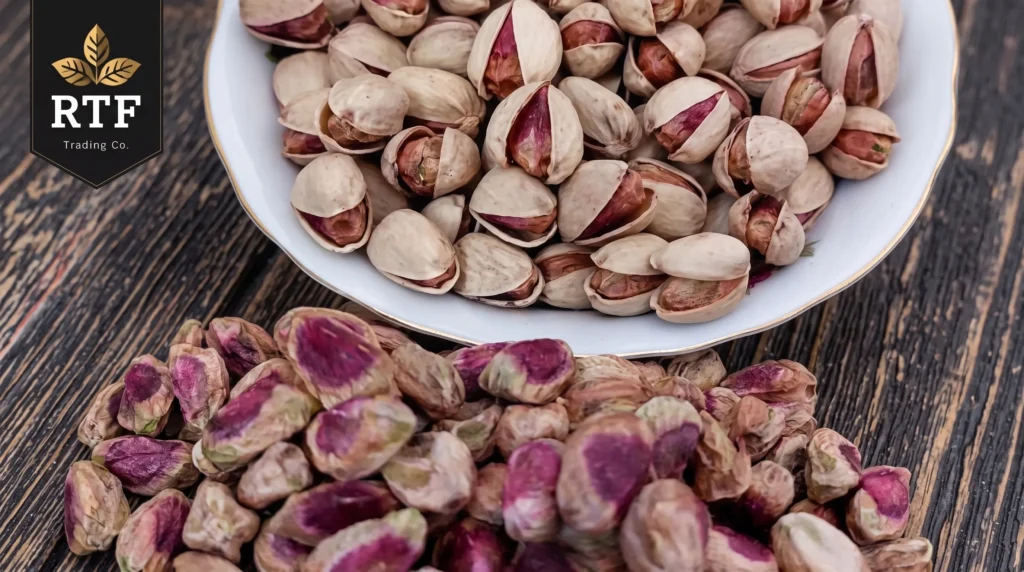
Ahmad Aghaei Pistachios
Ahmad Aghaei is another elongated Iranian variety. Its appearance makes it especially suitable for retail and export markets where presentation influences the purchase decision. Transparent packaging can work well because shoppers can immediately see the shape, shell quality, and consistency.
Fandoghi or Ohadi Pistachios
Fandoghi, commonly associated with the Ohadi cultivar, is rounder than Akbari or Ahmad Aghaei. It is often attractive to wholesale buyers who want a practical balance between price, appearance, availability, and volume.
It can be a strong option for supermarkets, bulk nut stores, mixed-nut products, and other high-volume applications.
Kalleh Ghouchi Pistachios
Kalleh Ghouchi is known for a large, broad, or jumbo appearance. Its size gives it strong shelf appeal and makes it suitable for premium in-shell sales.
But “jumbo” should not automatically mean “better.” Buyers should still compare freshness, shell opening, kernel development, defects, and consistency.
Turkish Pistachio Varieties
In addition, Turkey has a long tradition of Pistachio cultivation particularly in the south-eastern parts of the country.
Siirt Pistachios
Siirt is one of the better-known Turkish pistachio varieties. Its regional identity can appeal to specialty retailers, Middle Eastern grocery stores, and buyers looking for products with a clear origin story. For some customers, regional provenance adds value beyond the nut itself.
Uzun Pistachios
Uzun is another traditional Turkish variety and is associated with an elongated shape. For food businesses, differences among Turkish cultivars may matter in flavor, kernel characteristics, and suitability for processing.
Mediterranean Pistachios and Regional Specialties
Not every valuable pistachio is defined only by cultivar. In some markets, geographic identity is part of the product.
Aegina Pistachios
Aegina pistachios are strongly associated with the Greek island of Aegina. Their regional reputation makes them attractive to specialty retailers and Mediterranean food markets.
Larnaka Pistachios
Larnaka is associated with Cyprus and is also grown in other Mediterranean areas. For buyers purchasing kernels rather than in-shell nuts, color, flavor, moisture, and consistency usually matter more than shell appearance.
Bronte Pistachios
Pistacchio Verde di Bronte is an EU-protected Sicilian geographical product rather than simply a cultivar name. It is associated with gelato, creams, pastries, confectionery, and pistachio paste.
What Makes Different Types of Pistachios Different?
When comparing the different types of pistachios, consider attributes that will impact the end product.
Size and Shape
Nuts may be large or elongated, so as to impress visitors by forming a premium appearance. Rounder pistachios might be more convenient for larger quantities and when price and availability are more important.
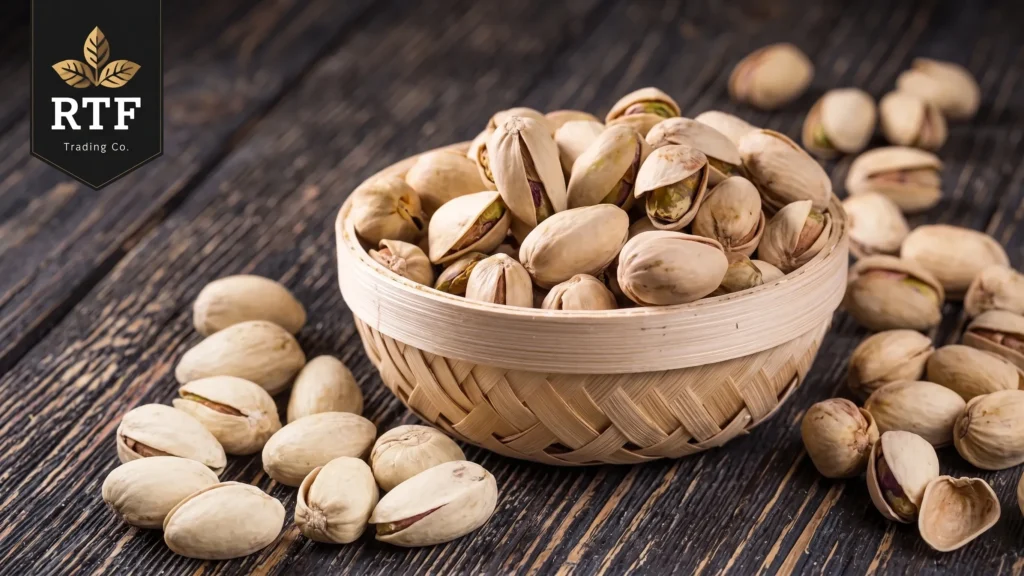
Kernel Color
Green kernels are useful in gelato, pastries, garnishes and pistachio products where colour is a requirement.
Natural Shell Opening
With regard to in shell snacking, naturally open shells are relevant due to the eating convenience they bring.
Uniformity
Packaging will appear cleaner and more professional because of its consistency in size and appearance.
Flavor and Freshness
The taste will vary with cultivar, origin, roasting, storage, and age. Sometimes freshness is more important than differences between varieties.
Grade and Defects
Closed shells, empty nuts, damaged kernels, irregular size and discolored spots lower the actual commercial value.
Best Pistachio Types for Different Uses
There are a variety of pistachio cultivars, and certain types are better suited for specific applications. The suitability of the pistachio for a sale depends on the best.
For Supermarkets and Everyday Retail
Typically, supermarkets require uniform quality, good shell opening, consistent supply, clean shells and competitive prices. Reliable = more useful than rare in high volume retail.
For Premium Nut Stores and Gift Boxes
First impressions are important. In these cases, large Kalleh Ghouchi nuts or pistachios sold by Long Akbari or Ahmad Aghaei may be good choices due to their presentation, which can support a higher price.
For Bakeries, Gelato Shops, and Food Manufacturers
Paying an extra for shell appearance is not worth it if the shell is going to be thrown away. The kernel color, flavor, freshness, moisture, skin percentage, roasting level, grinding suitability, consistency and price per usable kilogram are factors of importance in considering the characteristics of a kernel for its purchase. It is not always the most beautiful in-shell nut that is the best choice for paste, gelato or pastry.
Common Misconceptions About Pistachio Varieties
Pistachios are available in various varieties, but here are some common misunderstandings about pistachios:
Bigger Pistachios Are Always Better
Not necessarily. While large nuts may appear to be premium, a lower total premium could be enjoyed by small nuts with higher freshness and uniformity, and fewer defects.
Iranian Pistachios Are One Variety
They are not. There are several types of Iranian pistachio, such as Akbari, Ahmad Aghaei, Fandoghi, Kalleh Ghouchi and others. American pistachios also feature Kerman, Golden Hills, Lost Hills and others.
The Greenest Pistachio Is Always the Best
Color is just one quality factor, and green kernels are desirable for certain uses (particularly pastry and gelato). The criteria for people buying a snack may be the shell opening, freshness, flavor and size.
How to Choose Pistachios for Wholesale or Retail
Price comparisons can be misleading. Imagine Supplier A quotes a lower price per kilogram. Supplier B costs a little more. After checking samples, you discover that Supplier A has more closed shells and uneven sizing, while Supplier B offers cleaner, more uniform, mostly naturally open nuts. Supplier B may deliver better real value.
Before placing a large order, check:
- Cultivar or commercial type: Know what you are actually buying.
- Origin: Country and region can affect positioning and customer expectations.
- Size specification: Compare equivalent grades between suppliers.
- Natural-open percentage: Important for in-shell retail.
- Defect rate: Check blanks, closed shells, discoloration, and damage.
- Kernel quality: Review color, development, and appearance.
- Freshness: Ask about harvest timing and storage.
- Processing: Compare raw, roasted, salted, flavored, and shelled products correctly.
- Food-safety documentation: Request appropriate testing, traceability, and certifications for your market.
- Samples: Always inspect representative samples before a major purchase.
These checks often matter more than a famous variety name.
Final Verdict
different types of pistachios are available in a few varieties that differ in size, shape, flavor, appearance, origin and commercial value. There is no one variety that is ideal for all purchase. Before ordering different types of pistachios, consider cultivar, grade, freshness, shell opening, kernel quality, processing, and price, for wholesale, retail, or food production. Not only is the biggest and most expensive pistachio the smartest buy, but the smartest buy is the one that is best suited for your customer and use. When looking for different types of pistachios for a retail, supermarket, wholesale or food brand, it is important to compare samples and specifications side by side before ordering in bulk. A competent supplier will ensure that you know just what you are purchasing.
FAQ
What Are the Different Varieties of Pistachios?
Popular commercial pistachio varieties include Kerman, Golden Hills, Akbari, Ahmad Aghaei, Fandoghi, Kalleh Ghouchi, Siirt, Uzun, Aegina, and Larnaka.
How Many Different Types of Pistachios Are There?
Many cultivars exist, but only a smaller group is widely produced and traded.
Which Pistachio Variety Is Best?
There is no single best variety. The right choice depends on taste, appearance, intended use, quality requirements, and budget.
What Is the Difference Between Round and Long Pistachios?
Shape mainly depends on cultivar. Akbari and Ahmad Aghaei are elongated, while Fandoghi is generally rounder.
Are American and Iranian Pistachios Different?
Yes. Both countries grow multiple varieties with differences in size, shape, shell characteristics, flavor, and processing.
What Pistachio Is Best for Wholesale Buying?
Look for consistent quality, reliable supply, good shell opening, low defect rates, suitable size, and competitive pricing.