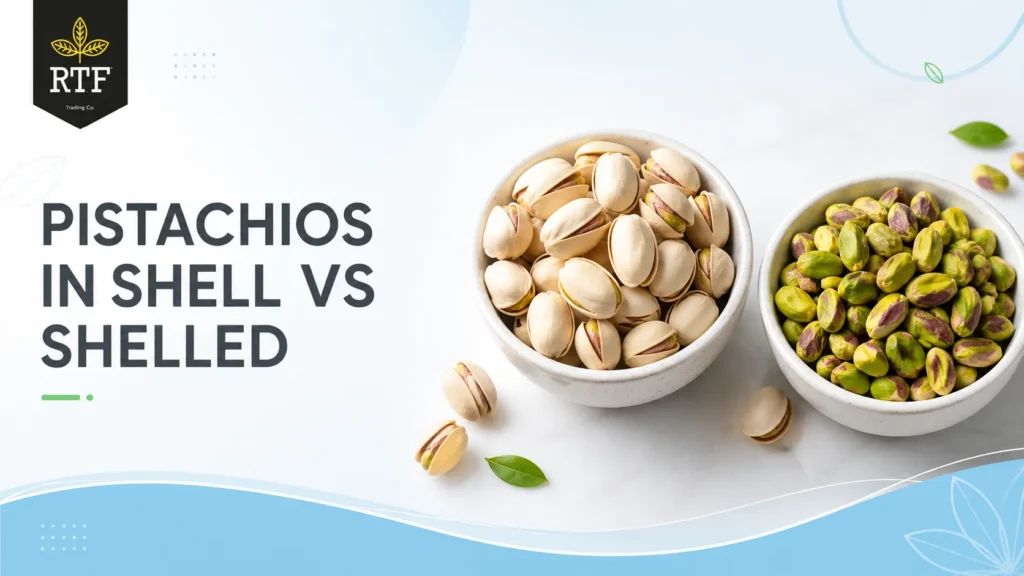
It might seem simple to purchase pistachios, but before you can, you are faced with two bags that appear to be unapproachable. One has whole pistachios still in their hard beige shell. The other is filled with ready-to-eat green kernels and typically is more expensive. So, which one offers better value?
This will depend on what you are going to do with them. In-shell pistachios tend to make for an easier-to-snack-on, better-for-snacking, and better-for-the-table option. Shelled pistachios tend to be more convenient to use in cooking, in mass production, in restaurants, or for anyone that values convenience. But the nutritional difference is not as significant as many consumers think.
This detailed comparison of pistachios shelled vs unshelled focuses on the flavour, nutritional profile, price, freshness, storage, convenience and commercial use. It doesn’t matter if the bag you want is for your kitchen or several tons for food manufacturing, knowing the truth can help you avoid paying for a product that is not exactly what you need.
What Do Shelled and Unshelled Pistachios Mean?
The description is confusing, as the term “shelled” seems to imply a nut with a shell still on. In food terms, it’s opposite.
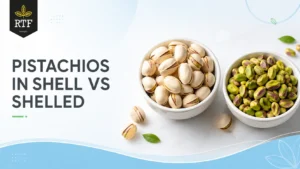
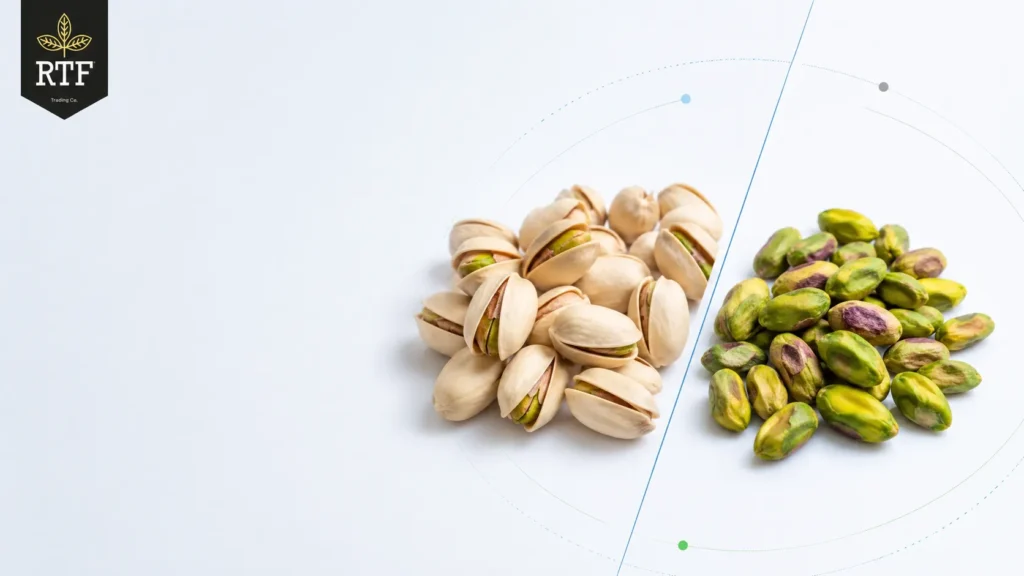
Shelled pistachios are the kernels that are taken out of the hard shell of the pistachio. They can be sold whole, as halves, pieces, roasted kernels, raw kernels, salted kernels, or blanched green kernels.
Unshelled pistachios still have their hard outer shells. They are also called:
• In-shell pistachios
The shell filled pistachios are called ‘Pistachios in the Shell’.
• Whole pistachios
• Shell-on pistachios
To avoid confusion, it is important to note that many suppliers and industry buyers refer to a more precise term, in-shell pistachios, or unshelled pistachios. Both of them are typically used to describe the same item.
This difference is also reflected in official quality standards. USDA has separate grading requirements for pistachio kernels in shell and shelled pistachio kernels, which include dryness, defects, mold, rancidity, shell fragments, kernel size and other factors.
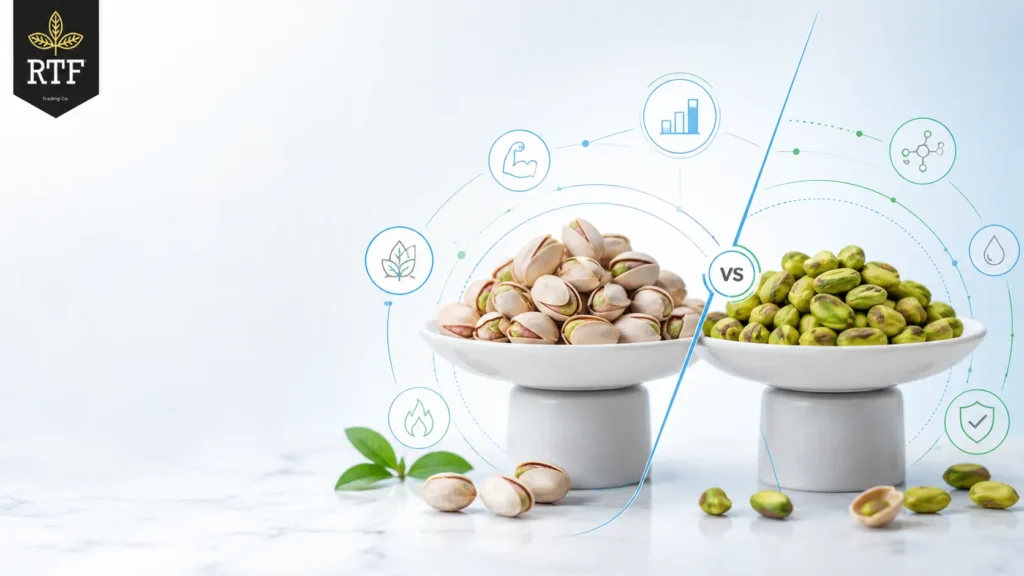
Pistachios in Shell vs Shelled: Quick Comparison
| Factor | In-shell pistachios | Shelled pistachios |
| Preparation | Must be opened individually | Ready to eat or use |
| Best use | Snacking and table service | Cooking, baking and processing |
| Portion control | Often easier because shelling slows eating | Requires more attention to serving size |
| Healthiness | Nutritionally similar, but may support slower eating and portion control | Nutritionally similar; healthiness depends more on salt, roasting method, and portion size |
| Price per package | Usually lower | Usually higher |
| Edible yield | Package includes shell weight | Almost entirely edible product |
| Storage protection | Kernel has a physical shell barrier | More exposed after processing |
| Labor requirement | Consumer or business removes shells | Supplier has already removed them |
| Waste | Produces discarded shells | Minimal consumer waste |
| Recipe convenience | Poor | Excellent |
| Visual presentation | Casual and interactive | Clean and professional |
What’s important is that there is no format that is always better. It will depend on your preference for taste, shelf life, time savings, looks or convenience.
Pistachios Shelled vs Unshelled Taste: Is There a Difference?
A lot of people say that fresh pistachios are better when they are bought “whole” from the shell. There may be some truth to that impression, but it isn’t really the shell that adds more flavor.
The taste of pistachios is influenced more strongly by:
- Freshness
- Pistachio variety
- Growing region
- Harvest quality
- Roasting temperature
- Salt level
- Moisture content
- Storage conditions
- Age of the product
A fresh, well-stored shelled pistachio is much more flavorful than an old or improperly roasted in-shell pistachio. Similarly, an in-shell pistachio of good quality is likely to be brighter and crispier than an opened container that has been kept for several months.
Why In-Shell Pistachios May Seem Fresher
Much of the kernel is enclosed in a hard shell. Even though naturally split pistachios are partially exposed, they are still subjected to some exposure by the shell, which is good for reducing direct handling and physical damage.
There’s also a psychological factor. Eating one at a time makes you eat more slowly. You see its aroma, texture, saltiness and crunch, rather than chewing on a few kernels at a time. Comparable to the idea of enjoying coffee out of a ceramic cup rather than a disposable cup. The coffee can be the same, but it is a different experience.
Why Shelled Pistachios Can Deliver Better Flavor in Recipes
Shelled kernels offer greater control when cooking. A chef has the option to lightly toast them, grind them to a pistachio paste, use them in pesto, or fold them into pastries without having to take an hour to remove their shells. Shelled pistachios are particularly good for using when the kernel is the only part that needs to be colored and flavored, such as:
- Baklava
- Pistachio ice cream
- Gelato
- Cookies
- Cakes
- Chocolate products
- Nut butter
- Salads
- Rice dishes
- Meat coatings
- Sauces
- Confectionery fillings
The consistency is usually more important than how easy it is to open the shell.
Pistachios in Shell vs Shelled Nutrition
Which is healthier, a raw or shelled pistachio? Not inherently. After the hard shell is removed, the kernel that is left is edible food. The amount of nutrients in a gram of edible pistachio kernel will be almost identical if the products are from similar whole pistachios and have been roasted, salted and processed in the same manner.
Unsaturated fatty acids make up about 45% of the fat content found in raw pistachio kernel, while the protein content is about 20% of the kernel’s weight. Pistachios are also rich in fiber and micronutrients and plant compounds. Typically the differences in major nutrient content are more related to processing than to shell status.
Salted vs Unsalted Pistachios
Salted pistachios can have a lot more sodium in them than unsalted pistachios. The importance of whether the nuts are sold shelled or in-shell isn’t significant.
A person with a low sodium diet should check the nutrition label and make sure that they don’t think that shell-on pistachios are healthier than the others.
Raw vs Roasted Pistachios
Roasting alters the flavor, texture and moisture. Depending on the type of oil used and how it is processed, oil-roasted products can also be different than dry roasted products. Again, it’s not really an issue of shelled versus unshelled. Both can be sold as raw, dry roasted, oil roasted, salted or lightly salted and flavored.
Flavored Pistachios
Seasonings such as barbecue, chili, lemon, garlic, honey, and others may include sodium, sugar, oil, or flavoring. Those in-shell products might then be easier nutritionally to digest than a plain shelled kernel, and vice versa. The best comparison is always between products containing the same ingredients.
Are pistachios in the shell healthier than shelled?
That’s where in-shell pistachios might offer a viable benefit. Eating the shells adds a natural pauses between bites. Having the empty shells will also serve as a clear indicator of pistachios consumed. This is also known as the “pistachio effect” by researchers.
In one study that had 140 university students, those who ate in-shell pistachios reported the same fullness and satisfaction as those who ate shelled pistachios but had fewer calories. The extra time and slower eating speed may have played a part in reduced intake, the researchers said. This isn’t to say shelled pistachios always lead to overshilling. They can also be served in a small bowl and eaten up directly from the bowl.
A pragmatic solution is easy:
- Weigh the number of servings of shelled pistachios.
- Place the package out of the way.
- Take a bite and take a bite, don’t go back to the bag over and over.
In-shell pistachios might have an easy time of moderation when it comes to absent-minded snacking during TV, work or travel.
shelled vs unshelled pistachios cost
Is It Better to Buy Pistachios Shelled or Unshelled for the Price? The price of the package is not all the answer. In-shell pistachios might be cheaper per pound but they have shells that you don’t eat. The labor, machinery, shell removal, sorting and quality control needed to get the edible kernels from the bags with shells all but done makes the shelled pistachio the higher cost option. So, you do need to look at the price per pound of edible kernel, not just the price per pound of packaged corn.
A simple cost comparison
Suppose that the following prices are hypothetical:
- One pound of in-shell pistachios: $8
- Shelled kernels at $14/pound.Shelled kernels are $14 per pound.
The in-shell product looks much less expensive on the surface. But if the yield of usable kernels from one pound of in-shells is about one-half or slightly more than one-half, the effective cost could be similar or higher than the price of the shelled product.
The kernel yield is dependent on various factors such as variety, size, shell thickness, moisture content, split rate, and lot quality. An average kernel weight ratio of about 62% was reported for split roasted samples in one study, giving reasons why actual rather than assumed yield should be measured.
Exact yield might not be important for a household that purchases pistachios to snack on. It’s a big deal for a bakery that consumes 100 kilograms of pistachio kernels a month.
Which is Fresher and Lasts Longer?
Pistachios contain a good amount of oils, and can go bad or rancid if subjected to heat, oxygen, moisture, or light. Shell offers some physical protection; storage conditions also are important for both formats. Pistachio post harvest handling research has revealed that temperature and relative humidity have an impact on the quality of lipids and the storage life. Quality is maintained under cool, controlled conditions.
The shelled pistachios are more susceptible to being protected improperly, since a greater portion of the edible surface is exposed. In-Shell Pistachios can be stored in a dry area of the refrigerator for as long as a year.
What Type is Best for the Home Consumer?
The best option for the majority of households is not to opt for one format for life. It is the acquiring of each type for a separate use.
Buy in-shell pistachios when:
- A slower snack
- A bowl for guests
- Portion awareness
- A more fun, participative meal.
- Snacks for movies and get-togethers
When to use shelled pistachios:
- A snack to curb any hunger between meals.
- A piece of yogurt or oatmeal.
- A salad ingredient
- A smoothie addition
- A baking ingredient
Nut mixture without any shell waste. A nut that is easy for children or older people to eat, even if they are able to handle nuts but not shelling the nuts themselves. A helpful homemaking tip is to store a bag of in-shell pistachios for snacking and a smaller in the refrigerator of unsalted kernels for recipes.
What type is best for Wholesalers and Importers?
Wholesalers and importers must consider more than consumer choice when making their decision. The format of the product influences freight efficiency, grading, market positioning, shelf space, repacking and customer needs.
Pistachios are a versatile nut that is suitable for a diverse range of applications.Pistachios are a versatile nut suitable for a wide variety of applications.
Advantages of In-Shell Pistachios for Wholesale Trade
Resellers in the snack market may be interested in in-shell products, as consumers can assess in-shell attributes like:
- Shell size
- Natural split
- Uniformity
- Staining
- External defects
- Overall appearance
Open shell, presentation is especially important in markets where pistachios will be consumed at holiday and family occasions or during traditional ceremonies.
Advantages of Shelled Pistachios for Wholesale Trade
Shelled kernels are more appropriate for a customer who is seeking edible components than an end consumer product.
Typical buyers include:
- Bakeries
- Confectionery companies
- Ice cream manufacturers
- Chocolate producers
- Nut butter brands
- Restaurants
- Catering companies
- Ingredient distributors
Commercial buyers should indicate if whole kernels, halves, pieces, granules, meal, flour, paste, raw kernel, roasted kernel, natural kernel or blanched green kernel are required.
They should also outline the acceptable levels of:
- Broken pieces
- Foreign material
- Shell fragments
- Moisture
- Rancidity
- Color variation
- Defects
- Aflatoxin risk
- Microbiological contamination
The term “shelled pistachios” is too general for a meaningful sales contract.
Which Type Is Best for Food Manufacturers?
Most food manufacturing uses are where shelled pistachios would be the top selection. Suppose a pastry factory makes 20,000 pistachio cookies each week. Purchase in-shell nuts would necessitate the use of machines or labor to open the nuts, remove the kernels, remove shell fragments, inspect and test the kernels, and dispose of the waste. This would be quickly offset by labor costs and inefficiency, because of the lower price.
Shelled kernels offer:
- Faster production
- More precise recipe formulation:
- Easier batch weighing
- Lower shell-fragment risk
- Predictable edible yield
Cleaner inventory calculations
High resistance to grinding and mixing machines. Manufacturers should still look at the need for whole kernels. If the pistachios are to be ground into paste, buying the pieces or broken kernels can save on ingredient expenses without compromising the final product. In a high quality chocolate bar, whole quality green kernels may be required. Pistachio butter doesn’t.
Which Type Is Best for Restaurants and Catering Businesses?
Shelled pistachios are typically purchased by restaurants as they save on the cost of kitchen staff. If a chef is making 50 plates of salmon with a crust of pistachio, that chef doesn’t want to have to open hundreds of shells during service. Shelled kernels offer quick, consistent and clean mise en place. In-shell pistachios are still a viable option for the hotel market. They can work well:
- In hotel minibars
- At bars and lounges
- On grazing tables
- At informal receptions
- In welcome baskets
- As a pre-dinner snack
The only drawback is that shells produce table and floor wastage. That’s an increase in clearing and cleaning in a busy venue. Shelled kernels will almost always be the better format for elegant plated food. In-shell pistachios can offer a more fun and enjoyable snacking experience for a relaxed party.
Common Misconceptions About Pistachios Shelled vs Unshelled
There are several common misconceptions about pistachios shelled vs unshelled.
“Shelled pistachios are less nutritious.”
Not necessarily. Removing the hard shell does not remove the kernel’s protein, healthy fats, fiber, or micronutrients. Differences usually result from roasting, seasoning, age, and storage.
“In-shell pistachios always taste better.”
Freshness and processing matter more. A stale in-shell nut is still stale.
“Unshelled pistachios are always cheaper.”
They may be cheaper per package weight but not per kilogram of edible kernel.
“Shelled pistachios are only for baking.”
They are also useful for salads, breakfast bowls, snacks, sauces, rice dishes, cheese boards, and savory meals.
“A closed pistachio shell means the kernel is bad.”
Not always. Some pistachios do not split naturally. However, tightly closed shells are inconvenient for snack products and may be separated during commercial grading.
“The shell makes pistachios healthier.”
The shell is not normally eaten. Its main possible benefit is behavioral: opening each nut may slow consumption.
Final Verdict
There’s no one clear winner when it comes to pistachios shelled vs unshelled. In-shell pistachios are perfect for those who want to enjoy eating the nut. They provide a slower speed, provide a visual cue to portions, and make a great social snack.
Shelled pistachios are most viable for use in cooking, baking, restaurants, catering and food manufacturing. They eliminate shelling labor, bring a measurable edible weight, save on preparation and easily fit into any recipe or processing line. Consider nutrition more on the quality of the product and less on its shell; roasting technique, freshness, ingredient list, and serving size.
When considering finances, compare the number of units of edible kernel, rather than just the printed cost per unit on the bag. The best option is the one that is fitting for the task. Purchase in-shell pistachios when you would like to take the time to savor the tradition. Purchase shelled kernels when convenience, consistency and efficiency are most important.
FAQ
Are pistachios in the shell healthier than shelled pistachios?
The edible kernels are nutritionally similar when the products have the same roast, salt level, and ingredients. In-shell pistachios may encourage slower eating and better portion awareness, but the shell does not add nutrition to the kernel.
Is it better to buy pistachios shelled or unshelled?
Buy in-shell pistachios for leisurely snacking and portion control. Buy shelled pistachios for recipes, commercial production, convenience, and accurate edible yield.
Do shelled and unshelled pistachios taste different?
They can, but the difference usually reflects freshness, roasting, salt, variety, and storage rather than the simple presence or absence of the shell.
Why are shelled pistachios more expensive?
Their price includes shell removal, sorting, quality control, processing losses, and the fact that nearly all the package weight is edible.
Are in-shell pistachios cheaper after accounting for shell weight?
Sometimes, but not always. Calculate the price based on the actual kernel yield and include any labor or waste costs.
Which pistachios are better for weight management?
In-shell pistachios may help some people eat more slowly and consume less because each nut must be opened. Portion-controlled shelled pistachios can also fit into a balanced diet.
Which type stays fresh longer?
The shell offers some physical protection, but temperature, oxygen, moisture, packaging, and storage time remain more important. Shelled kernels should be stored especially carefully in airtight packaging.
Can shelled pistachios be frozen?
Yes. Freezing properly sealed kernels is a practical way to maintain quality during extended storage. Allow the sealed package to return toward room temperature before opening so condensation does not form directly on the nuts.
Which type should food manufacturers purchase?
Most manufacturers should buy shelled kernels, pieces, granules, flour, or paste in the exact grade required by their production process.