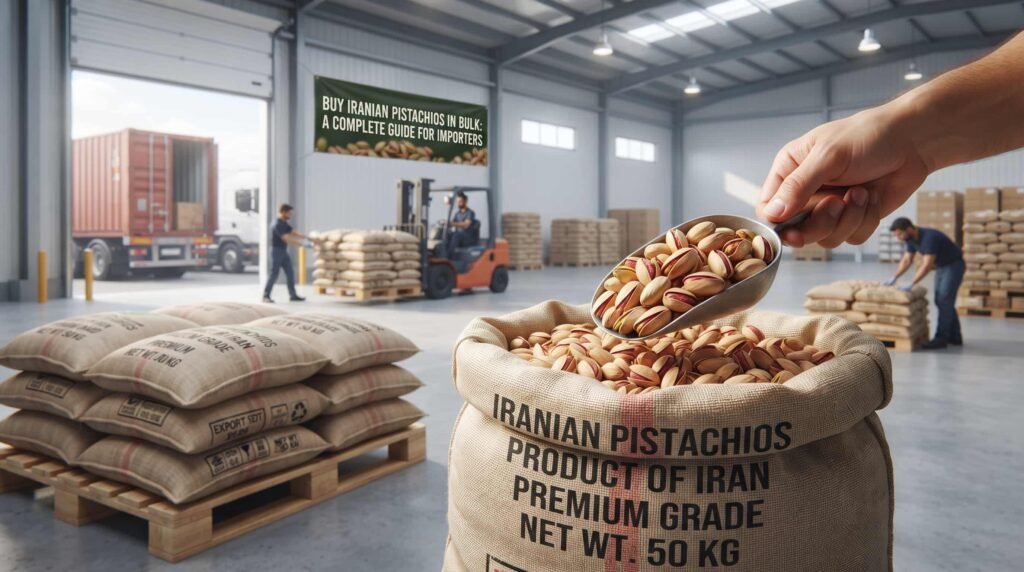
Buying Iranian pistachios in bulk can be a profitable sourcing opportunity for importers, wholesalers, food manufacturers, distributors and nut processors. Iran has a long history of pistachio cultivation and produces several commercially important varieties, including Akbari, Ahmad Aghaei, Kalleh Ghouchi and Fandoghi.
But buying pistachios in large quantities is very different from buying them as a retail product.
When you are importing several hundred kilograms or multiple tons, factors such as variety, size, grade, kernel quality, moisture, aflatoxin control, packaging, documentation, shipping terms and supplier reliability can have a major effect on the final cost and quality of your shipment.
This guide explains how professional buyers can source Iranian pistachios in bulk, compare suppliers, choose the right variety and specification, and reduce the common risks involved in international pistachio procurement.
Why Buy Iranian Pistachios in Bulk?
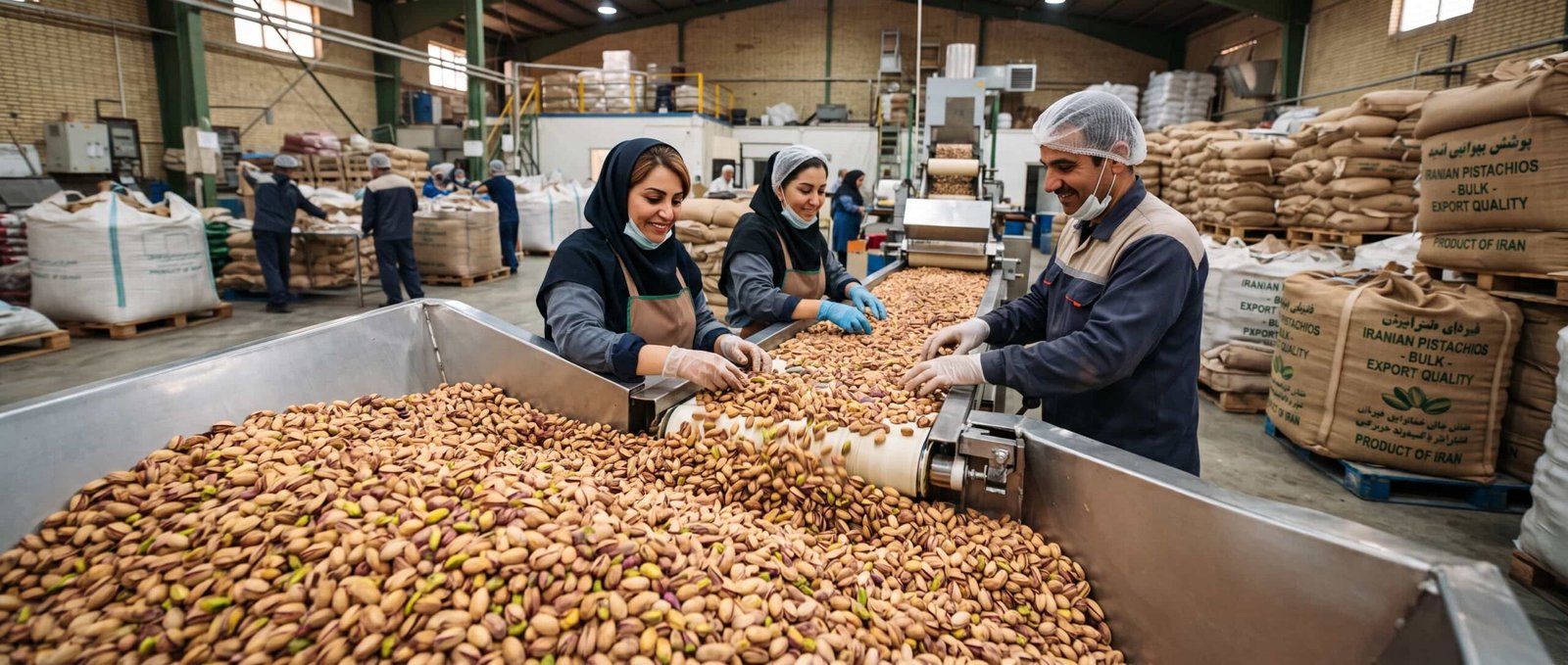
Iran is one of the historically important origins for pistachio production and international trade. Commercial Iranian pistachio varieties are generally divided into round and long types, with Fandoghi, Kalleh Ghouchi, Akbari and Ahmad Aghaei among the main commercial varieties.
For an importer, the advantage is not simply the origin itself. Iranian pistachios are available in different varieties, sizes and product forms, which allows buyers to source products for different market segments.
A food manufacturer may need pistachio kernels for confectionery, ice cream or pistachio paste. A distributor may prefer naturally open in-shell pistachios for roasting and retail packaging. Another buyer may be looking for green kernels for food manufacturing where appearance and color are more important than shell presentation.
This makes the first step in bulk sourcing surprisingly important:
Know exactly what you are buying before you start comparing prices.
A quote for “Iranian pistachios” is not enough.
Two suppliers can offer Iranian pistachios at very different prices because they may be offering different varieties, sizes, grades, processing methods or packaging specifications.
What Types of Iranian Pistachios Can You Buy in Bulk?
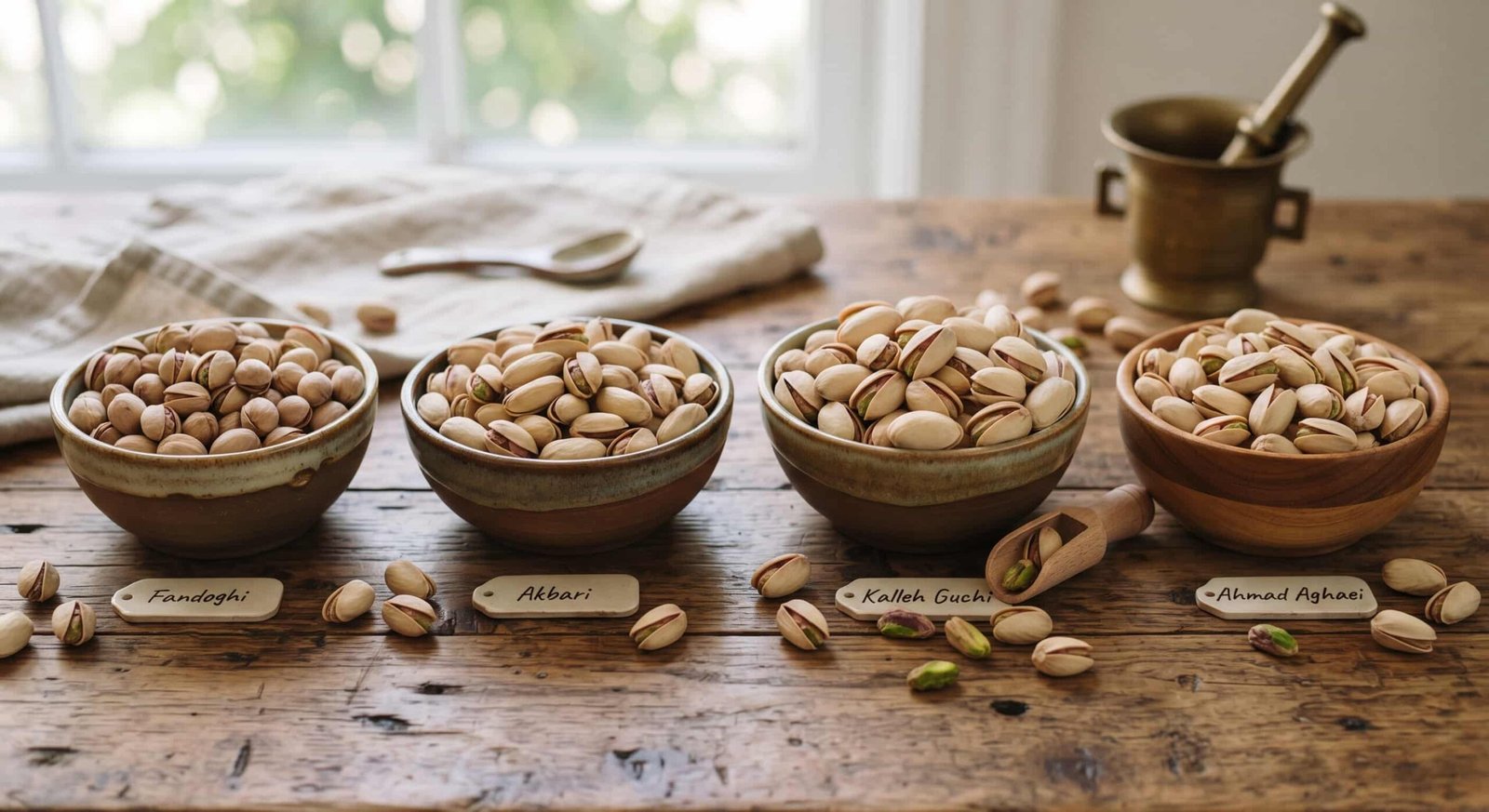
Iranian pistachios are sold in several commercial forms. The right option depends heavily on how you plan to use the product.
In-Shell Iranian Pistachios
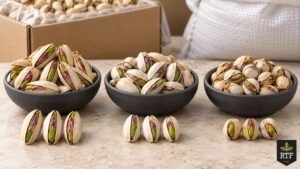
In-shell pistachios are widely used for snacking, roasting, retail packaging and foodservice. They are generally supplied according to variety, size, shell opening, appearance and other quality specifications.
Naturally open pistachios are highly valued in the snack industry because their naturally split shells make them easier to eat and give them an attractive appearance for retail consumers. However, shell opening is only one factor that influences product quality and market appeal. Nut size, shape and variety also play an important role in purchasing decisions. Buyers comparing Akbari vs Ahmad Aghaei vs Fandoghi Pistachios can better understand how these Iranian varieties differ in appearance, size and commercial suitability, helping them choose the right pistachios for their target market.
Bulk in-shell pistachios are often the starting point for importers who have their own roasting, seasoning, sorting or packaging operations.
Iranian Pistachio Kernels
Shelled pistachio kernels are more suitable when the buyer does not need the shell and wants to use the product as an ingredient.
They can be used in:
- confectionery
- chocolate
- ice cream
- bakery products
- pistachio paste
- pistachio butter
- desserts
- food manufacturing
Kernel specifications can be much more detailed than in-shell products. Buyers may need to define kernel size, color, whole or broken kernels, moisture, foreign material tolerance and other quality parameters before ordering.
Green Pistachio Kernels
Green kernels are particularly relevant for premium food applications where color is important. They can be used in products such as pistachio paste, desserts, ice cream, chocolate, bakery products and high-end confectionery.
For these products, simply specifying “pistachio kernels” is not sufficient. The buyer should clearly define the expected color and grade, as green kernel quality can have a significant impact on the final product. Proper pistachio quality control before export can help verify these characteristics before shipment. The Iranian Pistachio Association also identifies natural kernels and green kernels among the pistachio products exported from Iran.
Main Iranian Pistachio Varieties for Importers
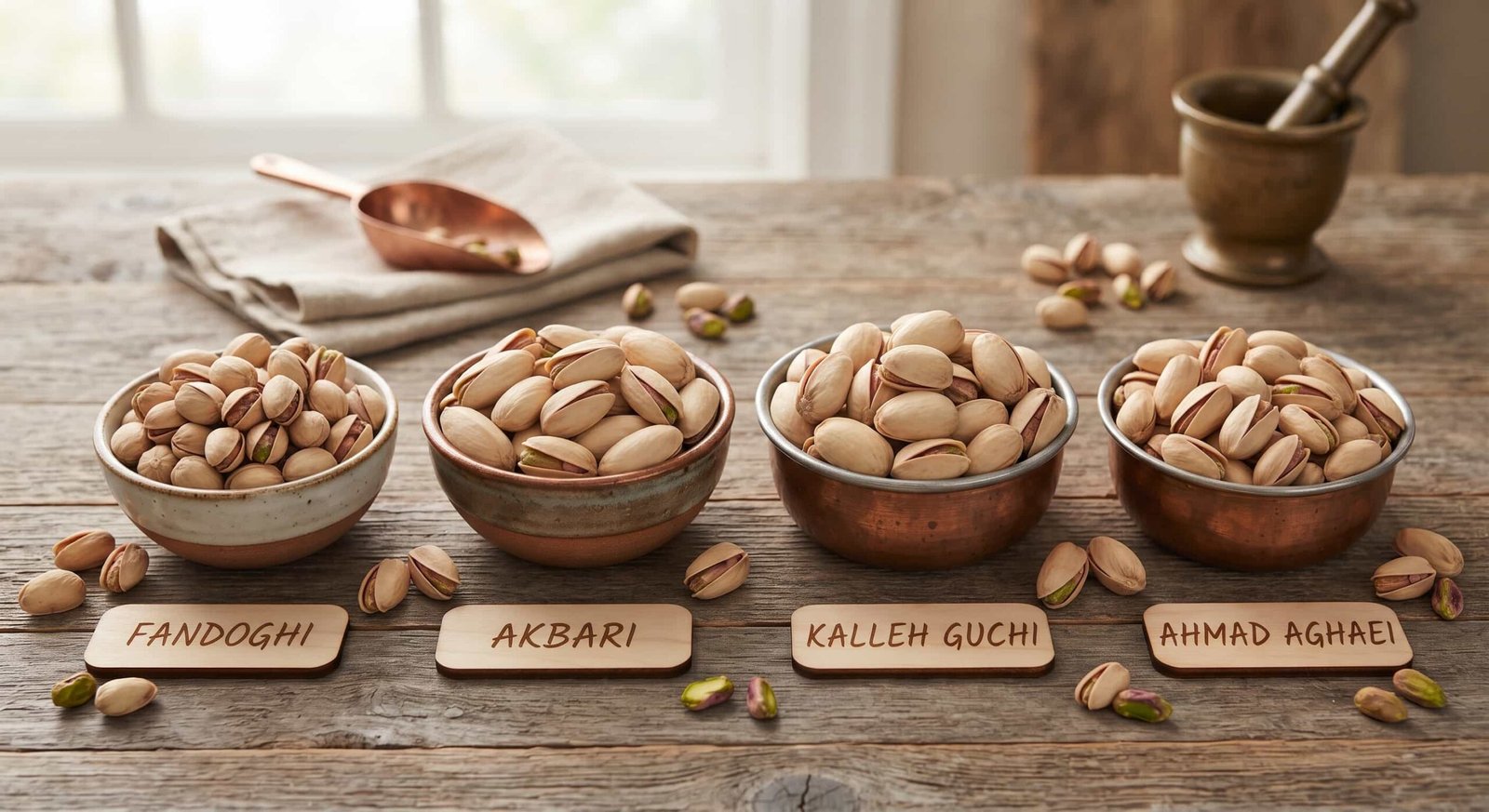
Choosing the right variety is one of the most important decisions in bulk procurement. Iran has several commercial cultivars, but four names appear frequently in international trade: Fandoghi, Kalleh Ghouchi, Ahmad Aghaei and Akbari.
Fandoghi Pistachio
Fandoghi is a round-shaped pistachio and is one of the most widely cultivated Iranian commercial varieties. Its relatively high availability makes it an important option for price-sensitive wholesale markets and large-volume applications. It can be suitable for buyers who need a commercially competitive product rather than focusing exclusively on premium long varieties.
Kalleh Ghouchi Pistachio
Kalleh Ghouchi, often referred to as Jumbo, is a round pistachio known for its relatively large size. Its appearance makes it attractive for snack markets and premium roasted pistachio products.
However, availability and production can fluctuate depending on growing conditions, which is one reason buyers should confirm the actual crop and available grade before negotiating a large contract.
Ahmad Aghaei Pistachio
Ahmad Aghaei is a long pistachio with an elongated shell and attractive appearance. It has become an important export variety and is used in markets where visual presentation is important.
For importers selling pistachios as a premium snack, the appearance of Ahmad Aghaei can be an important commercial factor.
Akbari Pistachio
Akbari is another long variety and is generally associated with large, elongated nuts. It is often positioned toward premium markets because of its appearance and size. For buyers targeting luxury snack products, gift packaging or premium retail, Akbari may be worth considering.
The important point is that variety should not be selected only because one name sounds more premium. The correct choice depends on your destination market, customer expectations, target retail price and required specification.
How Pistachio Size and Grade Affect Bulk Pricing
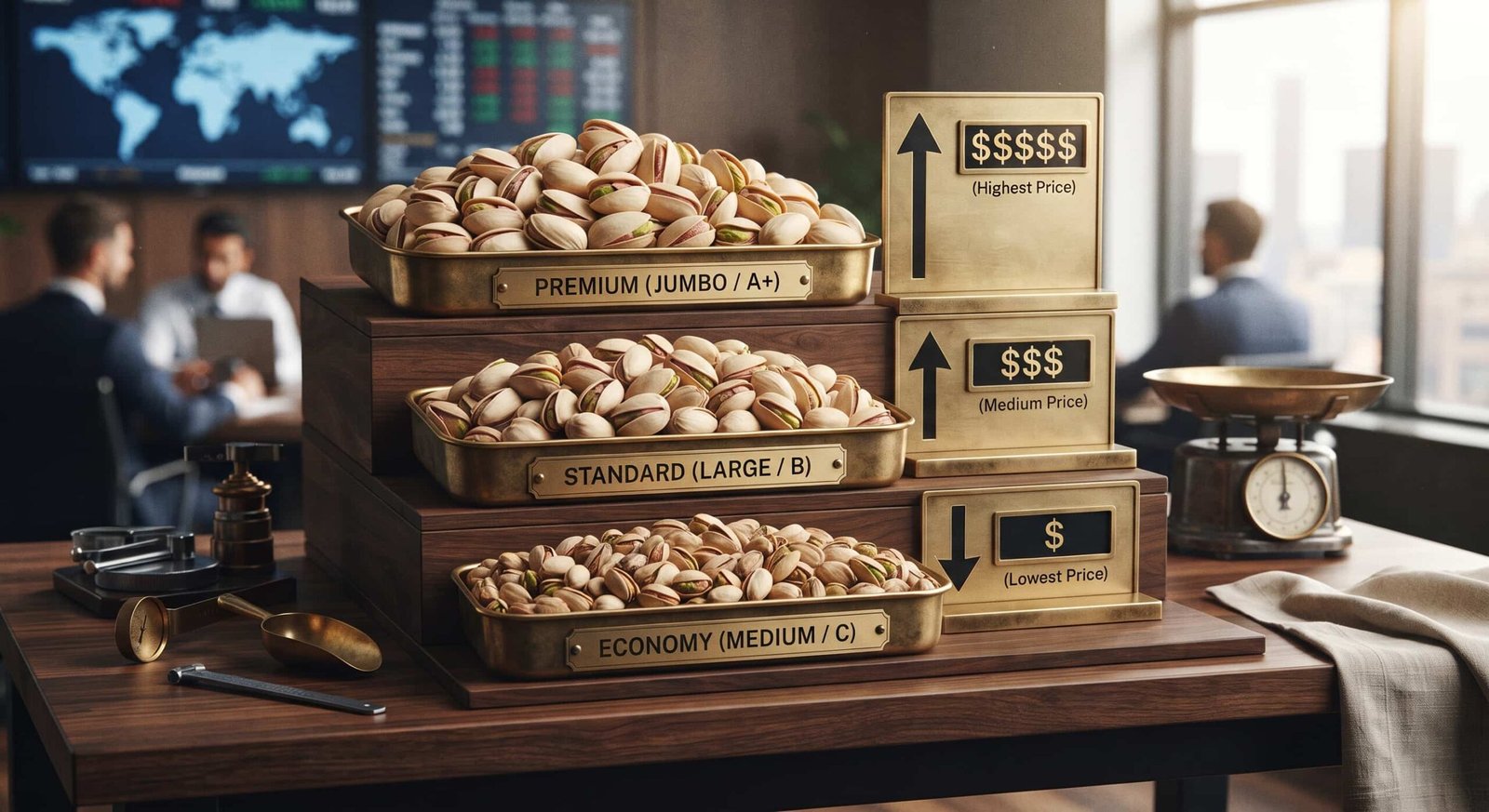
One of the common mistakes new importers make is asking for the “price of Iranian pistachios” without specifying the grade. Pistachio pricing can vary significantly according to size and quality.
In commercial trade, buyers may encounter sizing terminology based on the number of nuts per ounce or other grading systems. The lower the count in certain sizing systems, the larger the individual pistachios tend to be, which is an important consideration when choosing the right pistachio variety. For example, a buyer looking for a large premium in-shell pistachio should not compare the price directly with a smaller commercial grade.
Other factors can also influence the price:
- pistachio variety
- size
- natural opening
- shell appearance
- kernel color
- defect rate
- moisture
- crop year
- processing
- packaging
- order volume
- destination
- shipping terms
This is why a professional RFQ should contain a detailed product specification rather than simply asking:
“How much is Iranian pistachio per kilogram?”
A better request would identify the variety, form, size, grade, packaging, quantity and destination.
What Quality Factors Should Importers Check?
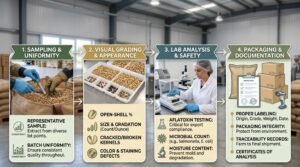
Price should never be the only consideration when purchasing bulk pistachios. A low purchase price can become expensive if the shipment contains inconsistent quality, excessive defects, moisture problems or fails the destination country’s food safety requirements.
Appearance and Uniformity
The pistachios should be reasonably consistent with the agreed specification. For in-shell products, buyers should evaluate shell color, shell cleanliness, opening characteristics and visible defects. For kernels, color and physical appearance become even more important.
Taste and Aroma
Fresh pistachios should have a natural nutty aroma and flavor. Any unusual rancid, stale, moldy or chemical smell should be investigated before accepting a shipment.
For large orders, a representative sample should be evaluated before finalizing the purchase whenever possible.
Moisture and Storage Condition
Moisture management is important because improper storage and transportation can affect product quality and shelf stability. Pistachios should be stored and transported under conditions appropriate for dried nuts, with protection against excessive humidity and contamination.
Foreign Material and Defects
The contract should define acceptable tolerances for foreign material, damaged nuts, insect damage, mold, immature nuts and other defects. Do not leave these specifications to verbal communication. They should be included in the commercial specification or purchase contract.
Aflatoxin Testing When Importing Iranian Pistachios
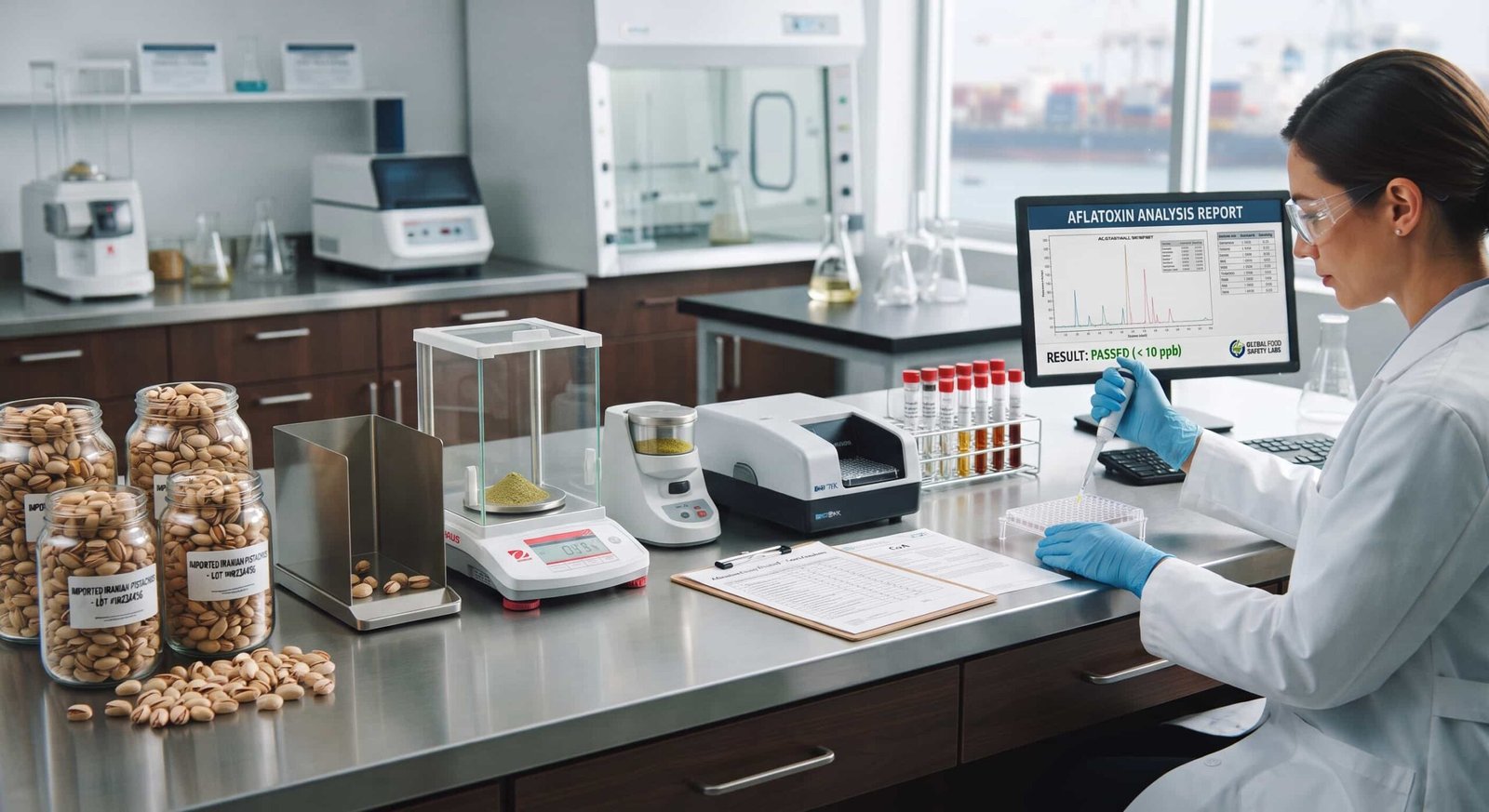
Aflatoxin is one of the most important food safety considerations when importing pistachios. This is not an area where an importer should rely only on a supplier’s statement that the product is “high quality.” The buyer should understand the specific requirements of the destination market and obtain appropriate laboratory documentation.
For example, U.S. regulations require imported pistachio lots intended for human consumption to comply with specific aflatoxin requirements. Under U.S. import regulations, lots exceeding 15 ppb total aflatoxin do not meet the specified import requirement, while testing and certification procedures apply. These requirements are also relevant when choosing between in-shell and shelled pistachios as food safety compliance must be considered regardless of the product format.
Requirements can differ between countries, so the specification should always be checked against the regulations applicable to the destination.
Before placing a large order, ask the supplier about:
- recent laboratory analysis
- aflatoxin testing
- sampling procedure
- certificate availability
- laboratory accreditation
- lot identification
- traceability
In 2025, the FAO also reported work in Iran focused on improving pistachio sampling and laboratory testing procedures for contaminants, including aflatoxin, highlighting how important food safety controls are in the pistachio supply chain.
How to Find a Reliable Iranian Pistachio Supplier
Finding suppliers is easy. Finding a supplier that can consistently deliver the specification you purchased is the difficult part. A professional importer should evaluate a supplier based on more than its website or quoted price.
Start by checking whether the supplier can clearly explain:
- Where the pistachios are sourced
- Which varieties are available
- What grades and sizes are available
- What quality tests are performed
- What documentation is provided
- What packaging options are available
- What the minimum order quantity is
- Which Incoterms are offered
- Which destinations they regularly supply
- How samples are handled
A supplier who cannot answer basic specification questions may create problems later in the process. The Iranian Pistachio Association identifies major commercial varieties and their characteristics, while current Iranian exporters commonly present products from producing areas such as Kerman and Rafsanjan.
Why Samples Matter Before a Bulk Order

Never judge a multi-ton purchase only from photographs. Pictures can show appearance, but they cannot properly demonstrate taste, aroma, moisture, texture, kernel quality or laboratory compliance. A better sourcing process is:
Supplier shortlist → specification → sample → laboratory checks → commercial quotation → contract → pre-shipment inspection → shipment
The sample should ideally represent the actual commercial grade being offered. Ask the supplier whether the sample is from the same lot or production specification that will be used for the final shipment. This is particularly important when buying premium varieties. A sample that looks excellent is not useful if the final cargo is sourced from a different grade.
What Should Be Included in a Bulk Pistachio RFQ?
When requesting a quotation, provide as much information as possible.
A professional RFQ may include:
| Specification | Example |
|---|---|
| Product | Iranian pistachios |
| Variety | Akbari / Ahmad Aghaei / Fandoghi |
| Form | In-shell / kernels |
| Grade | Agreed commercial grade |
| Size | Required size specification |
| Quantity | 5 MT / 20 MT / etc. |
| Packaging | Bulk / vacuum / customized |
| Destination | Buyer country and port |
| Incoterm | FOB / CFR / CIF / DAP |
| Required documents | COA, origin, phytosanitary, etc. |
| Target shipment | Required delivery window |
The more precise your RFQ is, the easier it becomes to compare suppliers. It also prevents suppliers from quoting completely different products under the same product name.
Bulk Pistachio Packaging Options
Packaging should be selected according to the product, transportation method, storage period and destination requirements.
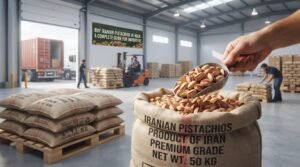
Common commercial formats include bulk bags, woven bags, cartons and vacuum packaging depending on whether the product is in-shell or shelled.
Some Iranian exporters currently offer formats such as 10 kg or 25 kg vacuum packs and larger bulk bags, while kernel suppliers may use smaller vacuum-packed units inside export cartons. These are examples rather than universal industry specifications, so packaging should be agreed with the supplier for each shipment.
For kernels, vacuum packaging can help protect the product from oxygen and moisture during storage and transportation.
For bulk in-shell shipments, packaging should be strong enough to withstand handling and international transport.
The buyer should also consider palletization, container loading, labeling and destination-country requirements before shipment.
Shipping Iranian Pistachios Internationally
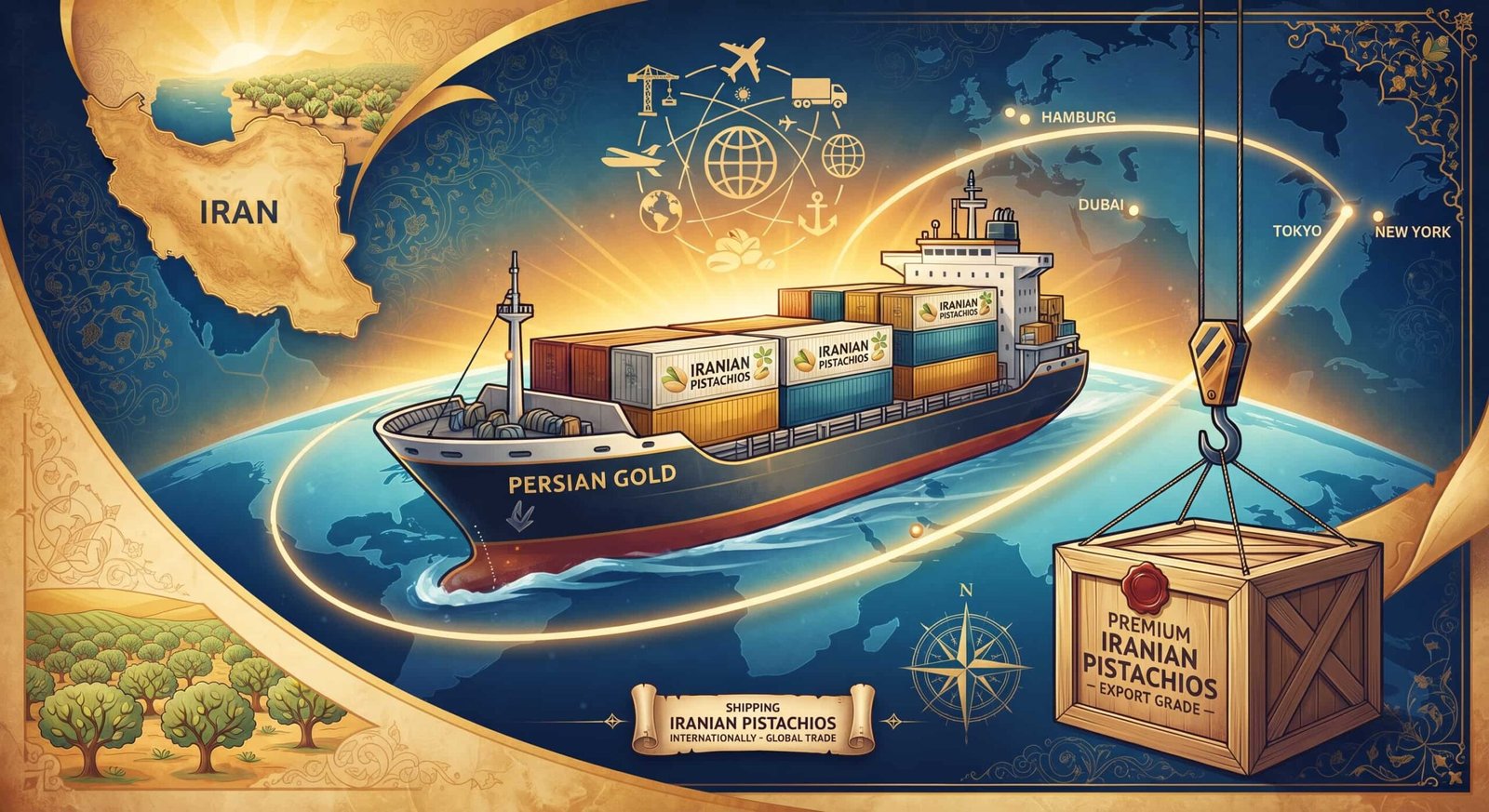
Transportation is another important part of the total landed cost. For large commercial orders, sea freight is generally considered when shipment volume makes container transportation economical.
Depending on the destination and trade route, overland or multimodal transportation can also be relevant. The shipping plan should be discussed before the commercial contract is finalized.
Important questions include:
- Which port will be used?
- Who arranges export clearance?
- Who pays for inland transportation?
- What is the agreed Incoterm?
- Who arranges marine insurance?
- What documents are required?
- What is the estimated transit time?
- How will the goods be handled during transit?
Do not compare supplier prices without comparing the delivery terms. A lower FOB price may not result in a lower landed cost than a higher CIF quotation once freight, insurance, customs and local charges are included.
Understanding Incoterms When Buying Iranian Pistachios
International buyers may encounter terms such as EXW, FOB, CFR, CIF and DAP. These terms determine which party is responsible for different parts of the transportation and risk process. For example, under FOB, the seller’s responsibilities differ from those under CIF or DAP.
The important thing is not choosing a particular Incoterm because it sounds cheaper. Instead, make sure both buyer and supplier understand exactly where responsibility and risk transfer. If you are a new importer, it is worth working with an experienced freight forwarder or customs professional who understands your destination market.
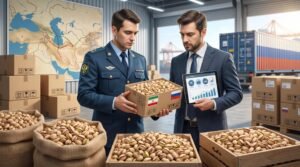
Documents You May Need When Importing Pistachios
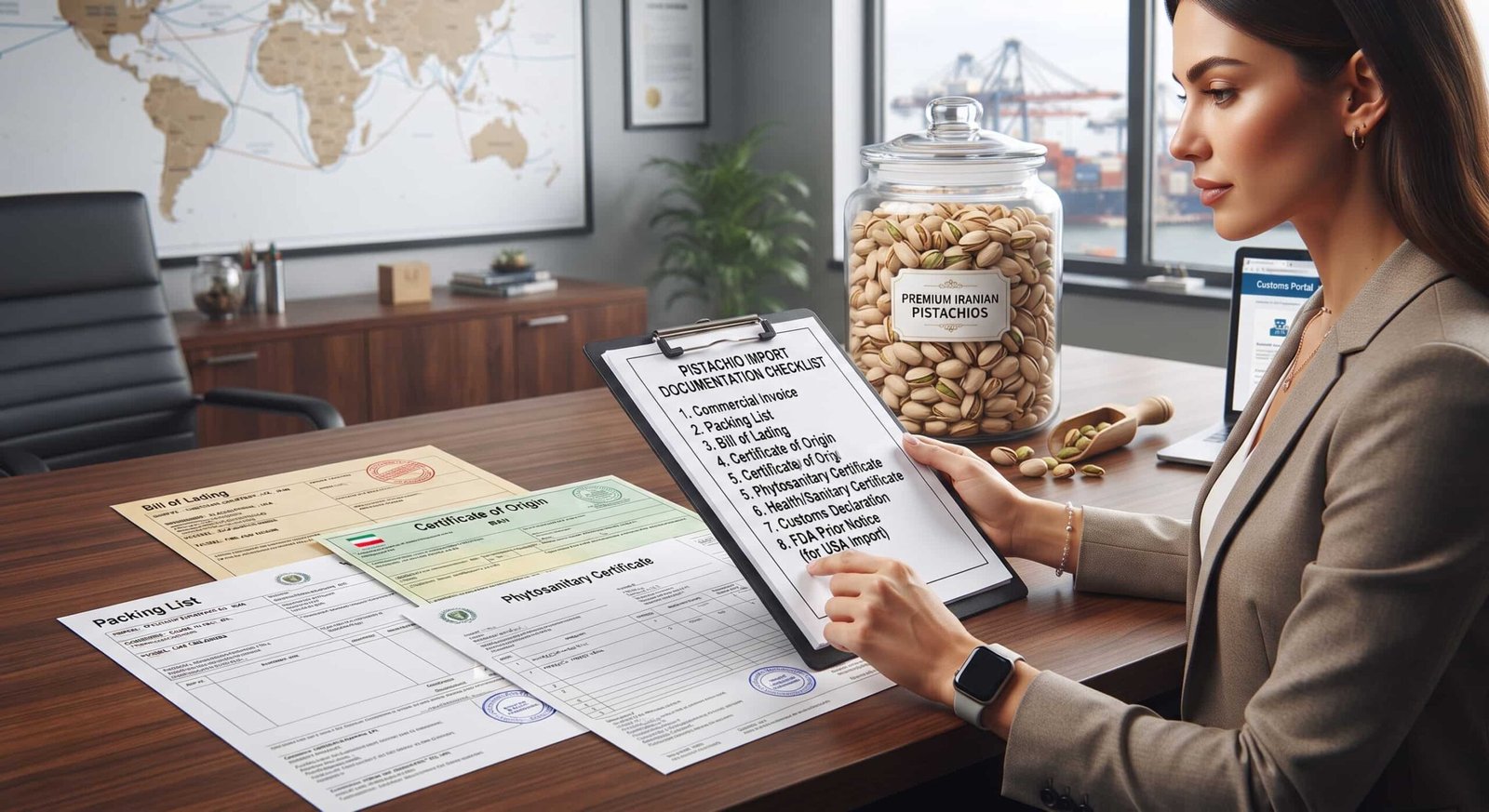
Documentation requirements vary by destination, product form and local regulations.
Depending on the shipment, importers may need documents such as:
- Commercial invoice
- Packing list
- Certificate of origin
- Phytosanitary certificate where required
- Certificate of analysis
- Aflatoxin test documentation
- Bill of lading
- Health or food safety documentation where applicable
- Import permits or registrations where required
Do not assume that one document package works for every country. For example, U.S. pistachio imports have specific aflatoxin inspection and certification requirements. Before ordering, check the current import requirements of your own country and product category.
How Much Does Bulk Iranian Pistachio Cost?
There is no single fixed price for Iranian pistachios. The price changes according to variety, grade, size, crop conditions, quantity, processing, packaging, destination and delivery terms.
This is why publishing one generic “Iranian pistachio price per kg” can be misleading for serious B2B buyers, particularly when importing Iranian pistachios into Russia. A buyer ordering one metric ton of a standard commercial grade should not expect the same quotation as an importer purchasing a container of large premium Akbari. The best way to obtain a meaningful price is to send a detailed RFQ. Ask suppliers to quote the same specification and the same Incoterm. Then compare the offers based on the landed cost, not simply the price shown on the quotation.
Common Mistakes When Buying Iranian Pistachios in Bulk
Choosing the Supplier Only by Price
The cheapest quotation may not be the cheapest shipment after considering quality, rejected goods, documentation problems and additional logistics costs.
Not Defining the Grade
“Iranian pistachios” is not a sufficient commercial specification. The contract should identify the exact variety, form, grade and relevant tolerances.
Skipping Sample Approval
A sample can reveal problems before thousands of kilograms are shipped. For large orders, sample approval should be part of the procurement process.
Ignoring Destination Regulations
A product that is commercially acceptable in one market may require additional testing or documentation in another. Always check destination-specific food safety and import regulations.
Comparing FOB and CIF Prices Directly
These prices do not represent the same cost structure. Compare equivalent Incoterms and calculate your expected landed cost.
Not Checking Supplier Traceability
You should know where the product comes from, how it was processed and how the lot can be identified. Traceability becomes particularly important if quality problems occur after arrival.
How to Build a Reliable Iranian Pistachio Supply Chain
For importers planning recurring purchases, the objective should not be finding one cheap shipment.
The objective is building a repeatable sourcing process.
A reliable supply chain usually involves:
Supplier qualification → product specification → sample approval → laboratory verification → contract → production and processing → inspection → documentation → shipment → arrival inspection
This process can reduce misunderstandings between the buyer and supplier.
It also makes future orders easier because the specification is already documented.
For larger businesses, it can be useful to maintain an approved supplier list and periodically compare suppliers based on quality consistency, delivery performance, documentation and commercial terms.
Iranian Pistachios for Different Business Models
The best pistachio variety depends on your business model.
- A wholesaler serving price-sensitive markets may prioritize volume and competitive pricing.
- A premium nut distributor may focus more heavily on appearance, size and long varieties.
- A confectionery manufacturer may prioritize kernels, color and processing characteristics.
- A food manufacturer may care more about technical specifications and consistent supply than shell appearance.
- A retail brand may require customized packaging, labeling and stable specifications across multiple shipments.
This is why the right question is not:
“Which Iranian pistachio is the best?”
The better question is:
“Which Iranian pistachio specification is best suited to my market and application?”
That distinction can save importers a considerable amount of money.
A Practical Checklist Before Buying Iranian Pistachios in Bulk
Before signing a large purchase contract, make sure you have answers to the following questions:
Product
- What variety am I buying?
- Is it in-shell or shelled?
- What exact grade is required?
- What size specification applies?
Quality
- Has the sample been approved?
- What are the accepted defect tolerances?
- What are the moisture requirements?
- Has aflatoxin testing been completed?
Supplier
- Where is the product sourced?
- Can the supplier provide traceability?
- Does the supplier regularly handle export shipments?
- Can they provide the required documentation?
Commercial
- What is the MOQ?
- What is the price per kilogram or metric ton?
- Which Incoterm applies?
- What payment terms are available?
Logistics
- Which port will be used?
- What packaging will be used?
- How will the shipment be palletized?
- What documents will accompany the cargo?
Destination
- What are my country’s import requirements?
- Are additional food safety certificates required?
- Is pre-arrival testing necessary?
- Who will handle customs clearance?
If these questions are answered before payment, the risk of unpleasant surprises is much lower.
Final Thoughts: How to Buy Iranian Pistachios in Bulk Successfully

Buying Iranian pistachios in bulk is not simply a matter of finding an exporter and asking for the lowest price. A successful importer starts with a clear specification.
You need to know the variety, size, grade, product form, application, quantity, packaging and destination before comparing quotations. From there, supplier verification, sample approval, laboratory testing, documentation and logistics become part of the purchasing process.
Iran offers several commercially important pistachio varieties, from Fandoghi and Kalleh Ghouchi to Ahmad Aghaei and Akbari, as well as different kernel and processed forms. The most important principle is simple:
Do not buy based on the product name alone. Buy based on a clearly defined specification.
If you are planning to import Iranian pistachios, prepare your required variety, grade, quantity, packaging and destination first. Then request comparable quotations from qualified suppliers and evaluate the complete landed cost, documentation and quality controls before making the final purchasing decision.
For regular importers, this approach does more than help find a supplier. It creates a more predictable procurement process and makes it easier to maintain consistent quality from one shipment to the next.
Frequently Asked Questions About Buying Iranian Pistachios in Bulk
What are the main Iranian pistachio varieties for export?
The main commercial varieties commonly discussed in the Iranian pistachio trade include Fandoghi, Kalleh Ghouchi, Ahmad Aghaei and Akbari. They differ in shape, size, availability and commercial applications.
Can I buy Iranian pistachios directly from suppliers in bulk?
Yes. Iranian pistachio exporters and suppliers offer bulk in-shell pistachios, kernels and other pistachio products for international B2B buyers. The available MOQ, grade and packaging depend on the supplier and product specification.
What should I check before buying Iranian pistachios?
At minimum, check the variety, grade, size, appearance, moisture, defect tolerances, aflatoxin testing, packaging, documentation, supplier traceability and delivery terms.
Are Iranian pistachios tested for aflatoxin?
Aflatoxin control is an important part of pistachio food safety. The exact testing and certification requirements depend on the destination market. For example, U.S. regulations establish specific aflatoxin requirements and certification procedures for imported pistachios.
What is the minimum order quantity for bulk Iranian pistachios?
There is no universal MOQ. Some suppliers accept smaller commercial quantities, while others focus on container-scale orders. The MOQ should be confirmed according to the variety, grade, packaging and destination.
How should I request a quotation for Iranian pistachios?
Provide the supplier with your required variety, product form, grade, size, quantity, packaging, destination and preferred Incoterm. This allows suppliers to provide a quotation that can actually be compared with competing offers.
What documents are needed to import Iranian pistachios?
The required documents depend on the destination. Common documents can include a commercial invoice, packing list, certificate of origin, bill of lading, certificate of analysis and phytosanitary or health documentation where required.
Which Iranian pistachio variety should I buy?
There is no single variety that suits every importer. Your choice should depend on your target market, application, customer expectations, required appearance, budget and technical specification.
How can I reduce the risk of a bulk pistachio purchase?
Use a written product specification, approve a representative sample, verify laboratory documentation, check the supplier’s export experience, clarify Incoterms and payment conditions, and confirm the import requirements of the destination country before shipment.