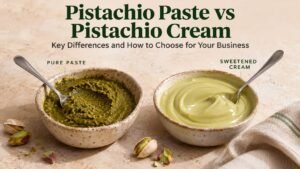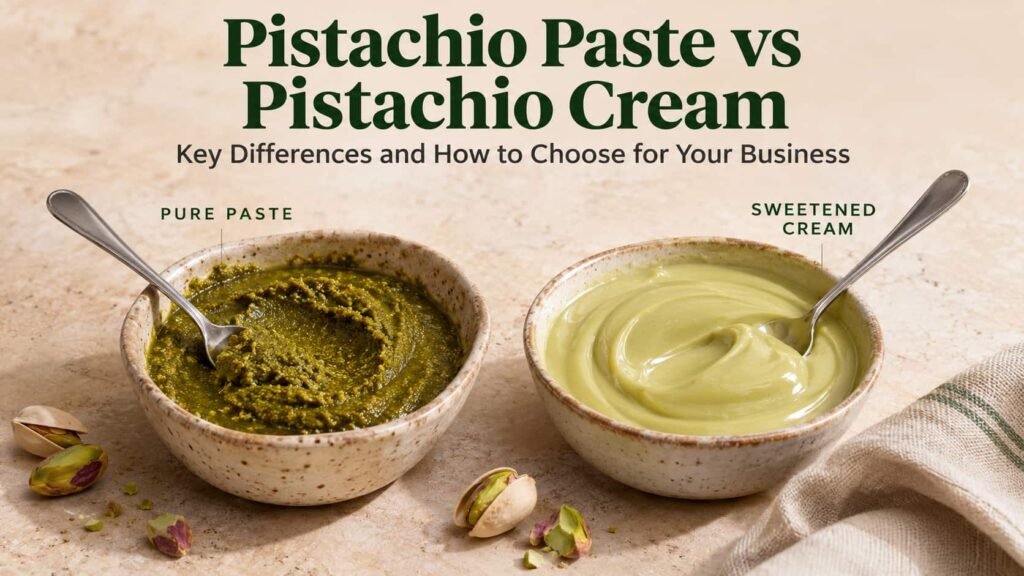
The main difference between pistachio paste and pistachio cream is their composition. Pure pistachio paste contains 100% ground pistachios. Pistachio cream usually combines pistachios with sugar and added fats and may contain milk ingredients or other components. Paste gives you a starting ingredient for formulation. Cream provides a prepared blend whose sweetness and texture are already partly determined.
For a food business, that difference affects purchasing as much as production. A bakery choosing a croissant filling has different requirements from a manufacturer developing a chocolate center. Understanding what each product contains helps you compare quotations properly and select an ingredient that works consistently in your finished product.
Pistachio Paste vs Pistachio Cream at a Glance
Product names are useful starting points, but they do not describe a complete specification. A product sold as pistachio paste is not automatically pure. Likewise, two pistachio creams may contain very different proportions of nuts. Always compare the ingredient declaration and technical information before deciding whether products are equivalent.
| Buying factor | Pure pistachio paste | Pistachio cream |
|---|---|---|
| Basic composition | 100% ground pistachios | Pistachios blended with other ingredients |
| Added sugar | None | Commonly present |
| Added fats | None beyond naturally occurring pistachio fat | May include vegetable fats or cocoa butter |
| Milk ingredients | Not part of a pure single-ingredient formula | May be present |
| Pistachio content | 100% when confirmed as pure | Depends on the formulation |
| Production role | Ingredient for developing a recipe | Prepared cream, spread or filling component |
| Texture | Depends on grinding and processing | Depends on the complete formulation |
| Suitability for baking | Evaluate within the finished recipe | Confirm whether the specific product is designed for baking |
| Main purchasing question | Does this paste meet our formulation requirements? | Does this prepared blend meet our application requirements? |
A higher pistachio percentage can be relevant to flavor and product positioning. However, it does not automatically make an ingredient the best commercial choice. Your decision should connect composition with production performance and the cost of delivering an acceptable finished product.
What Is Pistachio Paste?
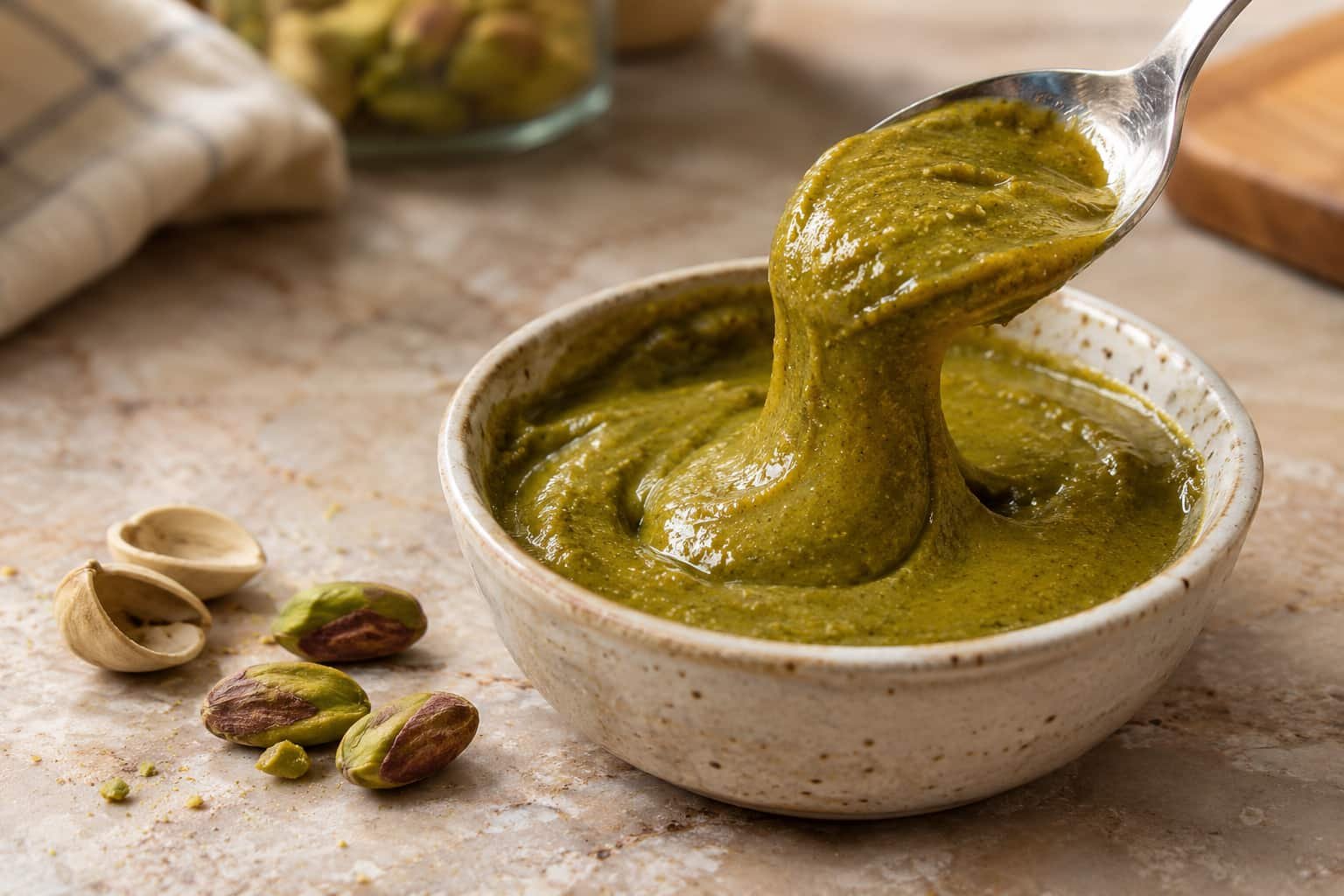
Pistachio paste is produced by grinding shelled pistachios. In a pure product, the pistachios are the only ingredient. Grinding releases their natural oil and creates a paste that can be incorporated into other formulations. The resulting flavor and consistency depend on the starting kernels and the processing method.
A commercial example is Callebaut’s Pure Pistachio Paste, which the manufacturer describes as an unsweetened product made from lightly roasted and finely ground pistachios. That description applies to the specific product. Other products using the word “paste” should be checked separately rather than assumed to have identical composition.
Pure Paste Gives You More Control Over the Recipe
A single-ingredient paste allows the development team to determine how much sugar and other fat to add separately. This is useful when the same pistachio ingredient will be used across several recipes. Each finished product can have its own sweetness and texture targets without starting from an already sweetened cream.
That flexibility also creates development work. Pure paste is not a complete filling simply because it has a smooth texture. A manufacturer still needs to establish the finished recipe and verify how it performs during production and storage.
Pistachio Paste and Pistachio Butter Can Overlap
Pistachio butter and pistachio paste can both refer to finely ground pistachios. American Pistachio Growers describes pistachio butter as shelled pistachios ground until their oil is released and a creamy paste forms. In purchasing, the name alone is therefore an unreliable way to distinguish the two.
For a useful comparison, ask whether the product contains only pistachios and request information about its grind and intended use. A retail nut butter and a paste developed for confectionery may fit different processes even when their ingredient lists appear similar.
What Is Pistachio Cream?
Pistachio cream generally combines pistachios with sweeteners and additional fats. Depending on the product, the formula may also include milk powder or other ingredients that influence flavor and handling. It can be supplied as a spread or as a professional ingredient for a defined production application.
There is no single pistachio percentage that describes every cream. IRCA’s professional range, for example, includes a cream containing 15% pistachios and another containing 25%. These examples illustrate why buyers should compare actual formulations instead of assigning one fixed composition to the entire category.
Cream Can Reduce Preparation Work
A prepared cream may suit a business that wants an ingredient with established handling characteristics. It can reduce the amount of blending required before filling or finishing a product. The practical benefit depends on whether its supplied consistency matches your equipment and portioning method.
However, convenience should be tested in your own process. Check how the cream dispenses at the intended working temperature and whether it delivers the expected result after storage. A product that works well by hand may require further evaluation before use on a filling line.
Pistachio Cream Is Not the Same as Fresh Dairy Cream
The word “cream” does not necessarily mean that the product is made with fresh cream or requires the same storage conditions. Some commercial pistachio creams are formulated as low-moisture spreads. Others have different compositions and handling requirements.
Use the manufacturer’s ingredient declaration and storage instructions for the specific product. Do not infer shelf life or refrigeration requirements from the product name or from whether milk powder appears in the formula.
How Flavor, Color and Texture Affect Your Choice
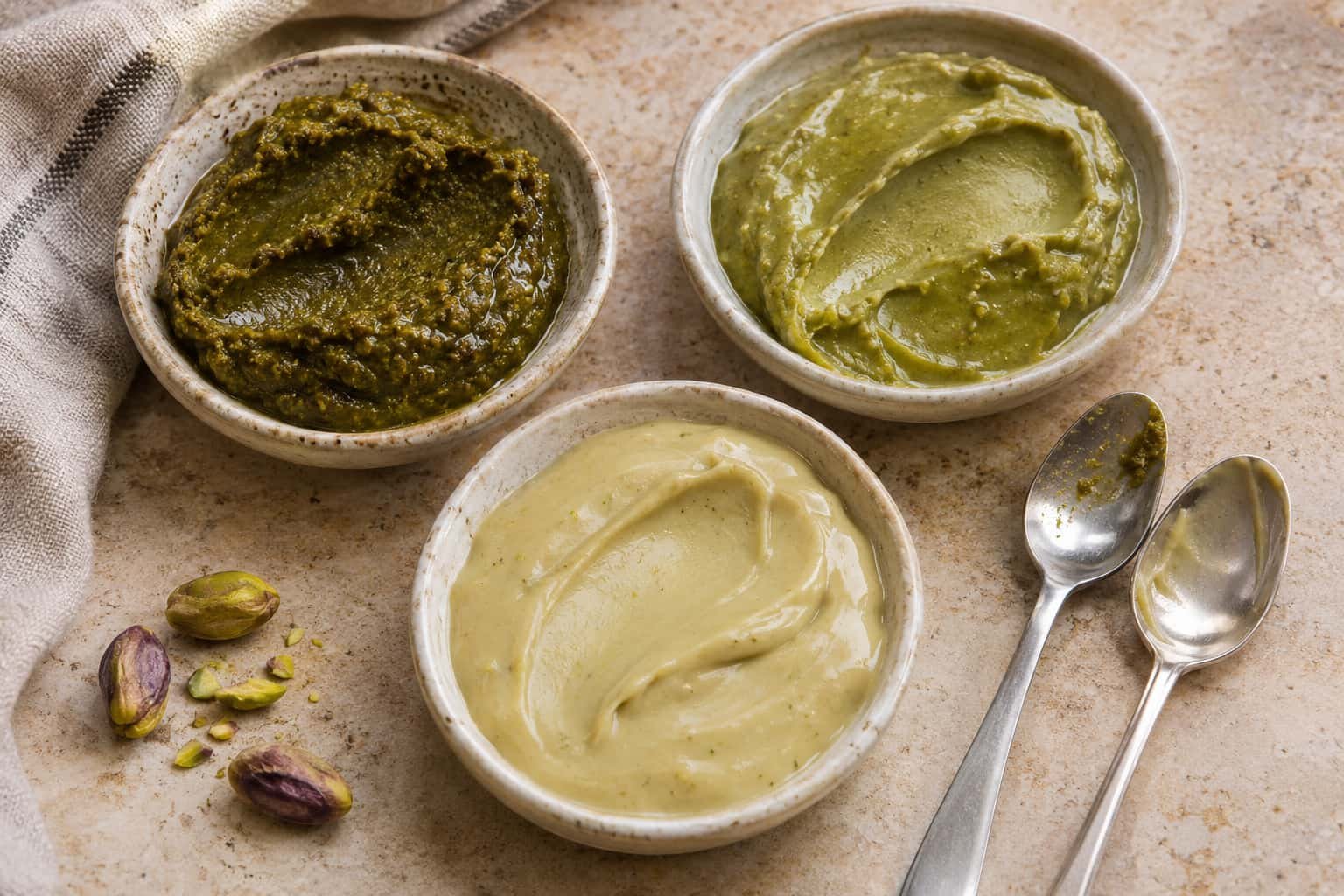
The best ingredient is the one that delivers the result your customers expect in the finished food. Comparing products directly from a jar can help with initial screening, but it does not show how they will perform after dilution or further processing. Make the final decision through comparable production trials.
Compare Flavor at the Intended Use Level
Pure paste and sweetened cream should not be expected to taste the same at an identical dosage. Their pistachio content and other ingredients differ. A fair trial evaluates each candidate in a formulation developed for that ingredient rather than substituting equal weights and judging the result immediately.
Record the amount used and the finished product’s sensory result. This makes it easier to distinguish an ingredient that is inexpensive to buy from one that is economical to use. The approved recipe should be the reference for purchasing decisions.
Green Color Does Not Establish Purity
A green appearance does not tell you the pistachio percentage or whether a product contains added coloring. The starting kernels and the complete formulation both matter. Judge appearance alongside composition and evaluate the color in the product you will actually sell.
If kernel selection is part of your development work, RTFNUTS lists early-picked Kall pistachios for commercial food applications. Request a representative sample and assess it against your target rather than selecting solely from a product photograph.
Specify the Texture Your Process Requires
Descriptions such as “smooth” or “spreadable” can mean different things to different suppliers. Explain whether the ingredient will be blended into a base or deposited directly as a filling. Your supplier needs to understand the job before recommending a product.
For a production trial, record the working conditions as well as the result. An ingredient that handles well under one set of conditions may behave differently elsewhere in the process. Written trial records provide a better basis for repeat purchasing than a general description of quality.
Which Should You Choose for Chocolate, Pastry and Desserts?
Start by deciding whether you want to develop a filling or purchase one with an established formulation. Pure paste may suit a business seeking control over its recipe. A prepared cream may suit an operation prioritizing a particular application and simpler preparation. Neither format is automatically superior across every product.
| Application | Ingredient approach to evaluate | Main point to verify |
|---|---|---|
| Custom chocolate filling | Pure paste incorporated into a developed formula | Finished filling performance |
| Dubai-style chocolate | A suitable prepared cream or a filling developed from paste | Compatibility with the crunchy components and chocolate shell |
| Pastry filled after baking | Cream or another specified ready-to-use filling | Dispensing and stored texture |
| Filling baked inside pastry | A validated recipe or a cream explicitly intended for baking | Performance under the actual baking conditions |
| Buttercream or dessert cream | Paste or a compatible formulated ingredient | Balance within the complete recipe |
| Ice cream and gelato | Ingredient selected through formulation trials | Performance in the finished frozen product |
Chocolate Fillings and Dubai-Style Chocolate
A chocolatier developing a distinctive filling may choose pure paste as one component of the recipe. A business seeking a prepared filling may evaluate a suitable pistachio cream instead. The purchasing brief should make clear whether you need a base ingredient or a product for direct incorporation.
For Dubai-style chocolate, evaluate the assembled bar rather than the filling alone. Include the crunchy component and chocolate shell in the trial. Define the texture you want at the intended serving conditions and check whether the product maintains that result through the planned storage period.
Croissants, Tarts and Baked Products
Confirm whether the ingredient is intended for use before or after baking. IRCA describes CUKICREAM PISTACCHIO as suitable for use before baking. Its CHOCOCREAM PISTACCHIO is described for after-baking filling operations. This distinction is more useful than a blanket rule about all pistachio creams.
When testing a baked filling, use your actual dough and production conditions. If the filling is added after baking, evaluate the dispensing operation and the texture of the assembled pastry. Keep these as separate approval processes.
Ice Cream and Gelato
Frozen dessert development requires an ingredient that fits the complete formulation. A pure paste and a sweetened cream contribute different components to the mix. Their use levels should be established separately rather than treated as interchangeable.
For a detailed discussion of kernel selection for this application, read our guide to pistachio kernels for ice cream and gelato. It covers the purchasing considerations specific to grinding, inclusions and decoration.
Can You Substitute Pistachio Cream for Pistachio Paste?
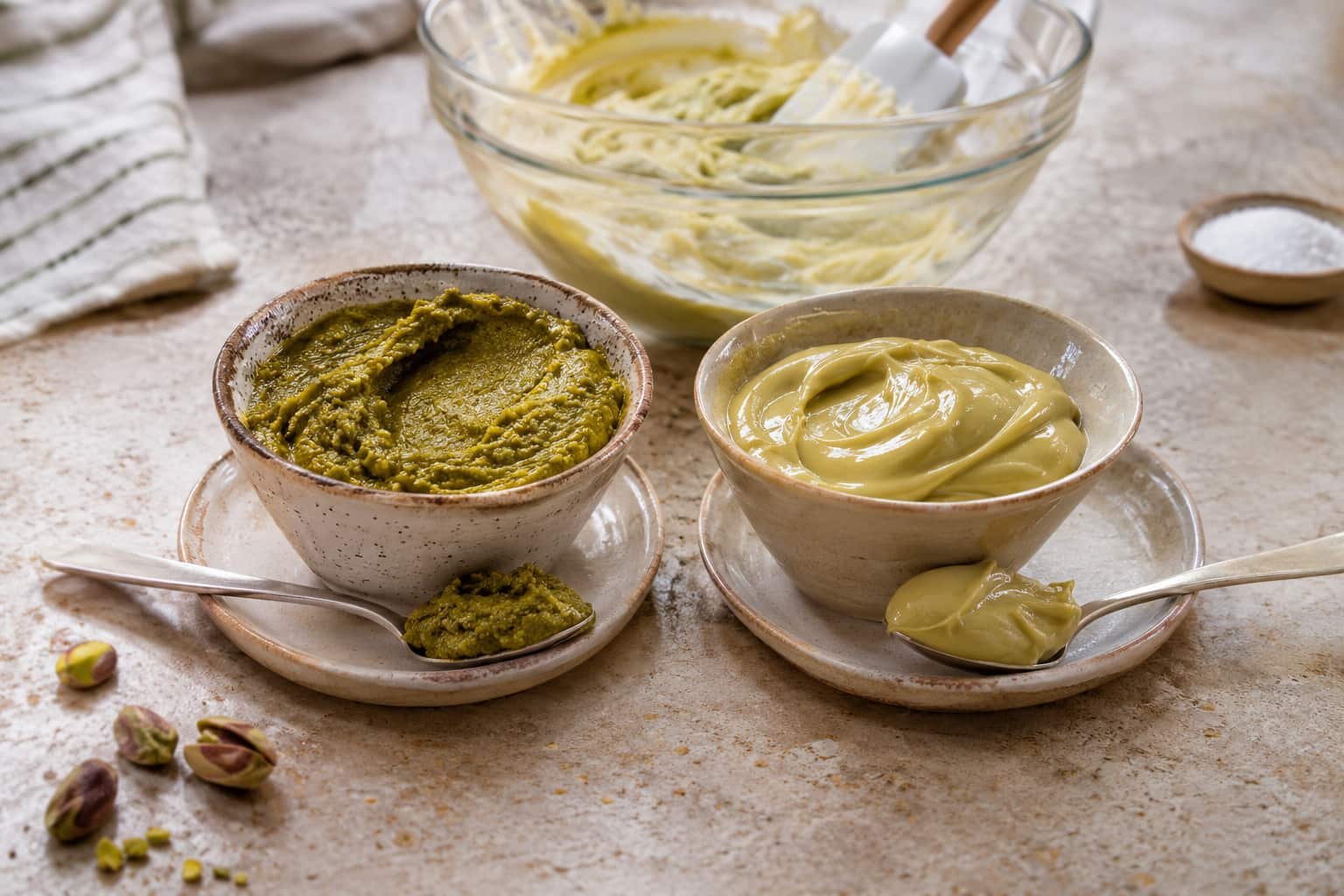
A substitution may be possible after reformulation, but it should not be treated as a direct weight-for-weight replacement. You are changing the amount of pistachio and potentially adding ingredients that were absent from the original formula. The rest of the recipe needs to be reviewed accordingly.
Consider an illustrative comparison. One kilogram of a 100% pistachio paste contains one kilogram of pistachios. One kilogram of a cream containing 30% pistachios contains 0.3 kilograms of pistachios. Using the same weight gives a different nut contribution before any other formulation differences are considered.
Adding more cream to match that pistachio contribution also adds more of its other ingredients. That calculation does not produce a validated substitute. It simply explains why a purchasing change needs a formulation review and a trial before a full production run.
How to Compare Cost Beyond the Price per Kilogram
A lower ingredient price does not necessarily produce a lower finished-product cost. A useful comparison includes the amount used in an approved recipe and the preparation required. Compare alternatives only after establishing that both deliver an acceptable product.
The following example is hypothetical. It is not a current RTFNUTS quotation or a recommended recipe. Assume two independently developed fillings have passed the business’s own quality review.
| Cost item for a 10 kg finished filling | Filling developed with pure paste | Filling developed with prepared cream |
|---|---|---|
| Main pistachio ingredient price | $24/kg | $12/kg |
| Main ingredient used | 2 kg | 6 kg |
| Main ingredient cost | $48 | $72 |
| Remaining formulation ingredients | $24 | $10 |
| Assigned preparation cost | $12 | $5 |
| Total batch cost | $84 | $87 |
| Cost per kilogram of filling | $8.40 | $8.70 |
In this example, the more expensive main ingredient produces a slightly lower batch cost. Different recipes could reverse the result. The purpose of the calculation is to compare actual production options rather than draw a general conclusion that paste or cream is always cheaper.
For purchasing approval, use your own quoted prices and measured output. Record preparation time and any meaningful losses. Review whether the operational simplicity of a prepared cream justifies a cost difference for your business.
Buying Kernels to Produce Your Own Pistachio Paste
Businesses with suitable processing capability may choose to buy kernels and make their own paste. American Pistachio Growers identifies raw kernels as an option for making pistachio flour, paste and butter. This route should be assessed against the work and controls required at your facility.
RTFNUTS offers a bulk pistachio kernel range for commercial buyers. When making an inquiry, explain whether the kernels will be ground into paste or used in another production step. This helps the supplier discuss appropriate options and specifications.
Choose the Kernel for the Intended Output
A kernel purchased for grinding does not necessarily need the same appearance as a whole kernel sold as decoration. However, the offered lot still needs to meet your agreed quality requirements. Compare representative samples through your process before selecting a grade.
For example, Fandoghi pistachio kernels are listed by RTFNUTS for confectionery and food-processing applications. Evaluate their suitability through a trial and quotation rather than assuming that one variety is the correct choice for every paste formula.
Include the Work Required After Delivery
Buying kernels transfers more of the production work to your own operation. Assess the processing steps your facility can perform consistently and calculate their costs before comparing the route with purchased paste. Include the effort needed to approve and release the finished ingredient.
If your business lacks the required processing capacity, a suitable prepared ingredient may be more practical. If you already have an established process, kernel sourcing may give you another option to evaluate. The decision should follow your capabilities and required output.
What to Request Before Placing a Bulk Order
A useful inquiry gives the supplier enough information to recommend an appropriate product. State the finished application and required quantity. Then identify the composition and performance requirements that will determine whether a sample is acceptable.
| Specification area | Information to request or agree |
|---|---|
| Composition | Pistachio percentage and complete ingredient declaration |
| Processing | Relevant treatment and preparation details |
| Performance | Intended application and handling requirements |
| Appearance | Approved sample or agreed reference |
| Packaging | Net weight and suitable pack format |
| Storage | Product-specific instructions before and after opening |
| Documentation | Applicable quality records and traceability information |
| Supply | Availability and requirements for repeat orders |
Use sample approval to establish a reference for the order. Ask whether the sample represents a particular lot or a general product specification. Keep the approved characteristics in writing so future deliveries can be assessed consistently.
For the wider relationship between inspection and shipment documentation, see our guide to pistachio quality control before export. Product appearance should be considered alongside the verification requirements agreed for the purchase.
Frequently Asked Questions
Is Pistachio Paste the Same as Pistachio Cream?
They generally describe different formulations. Pure paste contains only ground pistachios. Cream commonly includes sweeteners and added fats. However, commercial terminology varies. Check the full ingredient declaration and pistachio percentage instead of relying solely on the name printed on the container.
Is Every Pistachio Paste Unsweetened?
No. A product explicitly specified as 100% pure pistachio paste should contain only pistachios. Other products sold as paste may have different compositions. Confirm the ingredient list before using a supplier’s description as the basis for formulation or purchasing approval.
Which Is Better for a Bakery?
The better choice depends on the bakery’s products and production process. Paste may suit recipes developed in-house. A prepared cream may simplify a particular filling operation. If the ingredient will be baked, confirm suitability for that use and approve it under your actual production conditions.
Can I Make Pistachio Cream from Pure Paste?
Pure paste can be used as a component when developing a pistachio cream. The remaining ingredients and processing method determine the finished result. A commercial product still needs a validated formulation and appropriate storage guidance. Starting with pure paste does not establish the finished cream’s shelf life.
Does Pure Paste Always Have a Longer Shelf Life?
No universal comparison should be assumed. Processing and packaging influence storage performance alongside composition. Follow the supplier’s instructions for the exact ingredient. When you incorporate it into another recipe, establish the finished product’s storage requirements separately.
Find the Right Pistachio Ingredient for Your Production
Choose pure paste when its composition and flexibility support your formulation. Choose a prepared cream when the specified blend fits your application and production needs. If you plan to make paste yourself, assess suitable kernels alongside the cost and capability of your own process.
RTFNUTS can discuss available Iranian pistachio kernels for commercial sourcing. To request a sample or wholesale quotation, share your intended application, estimated quantity and destination country. Include any established specifications so the team can review suitable available options for your production.