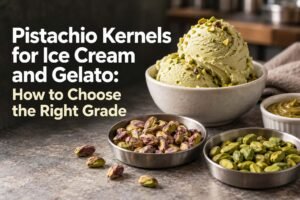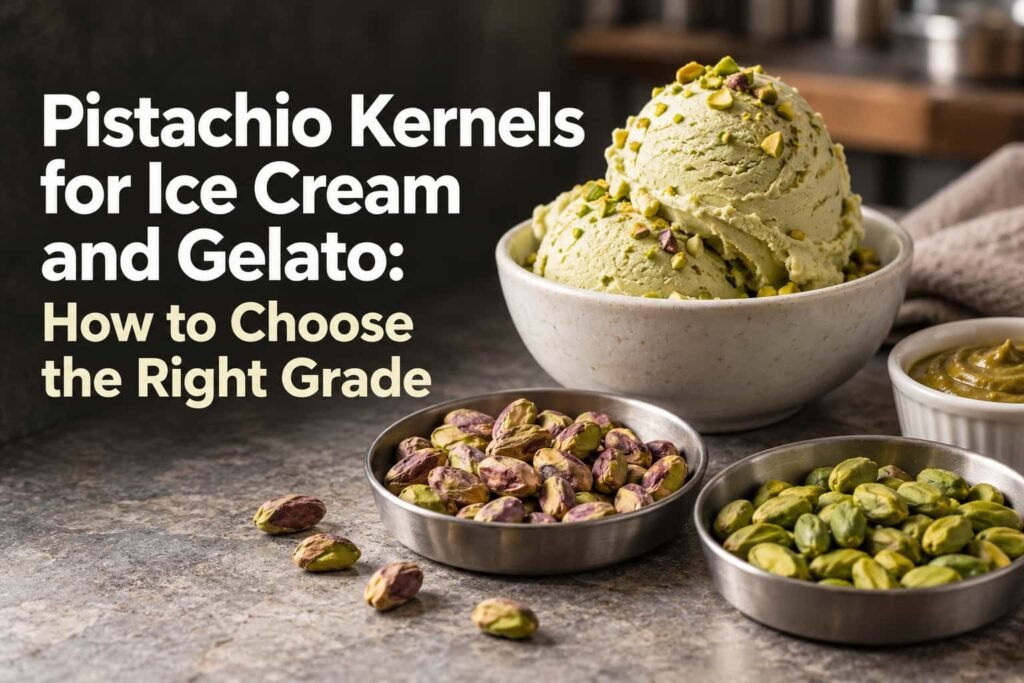
Choosing pistachio kernels for ice cream is a production decision as much as a purchasing decision. The ingredient needs to deliver the flavor, color and texture your customers expect while fitting your equipment and target cost.
The greenest kernel is not automatically the best choice. Neither is the largest whole kernel or the lowest-priced batch. A product selected for grinding into a smooth base may need different characteristics from pistachio pieces added for texture.
The right grade is the one that performs consistently in your finished product. To find it, start with the application. Then compare representative samples against a written specification.
This guide explains how to evaluate pistachio kernels for ice cream and gelato production. It covers product formats, color, roasting, purchasing specifications and the cost calculations that matter before a wholesale order.
Start with the Job the Pistachio Must Do
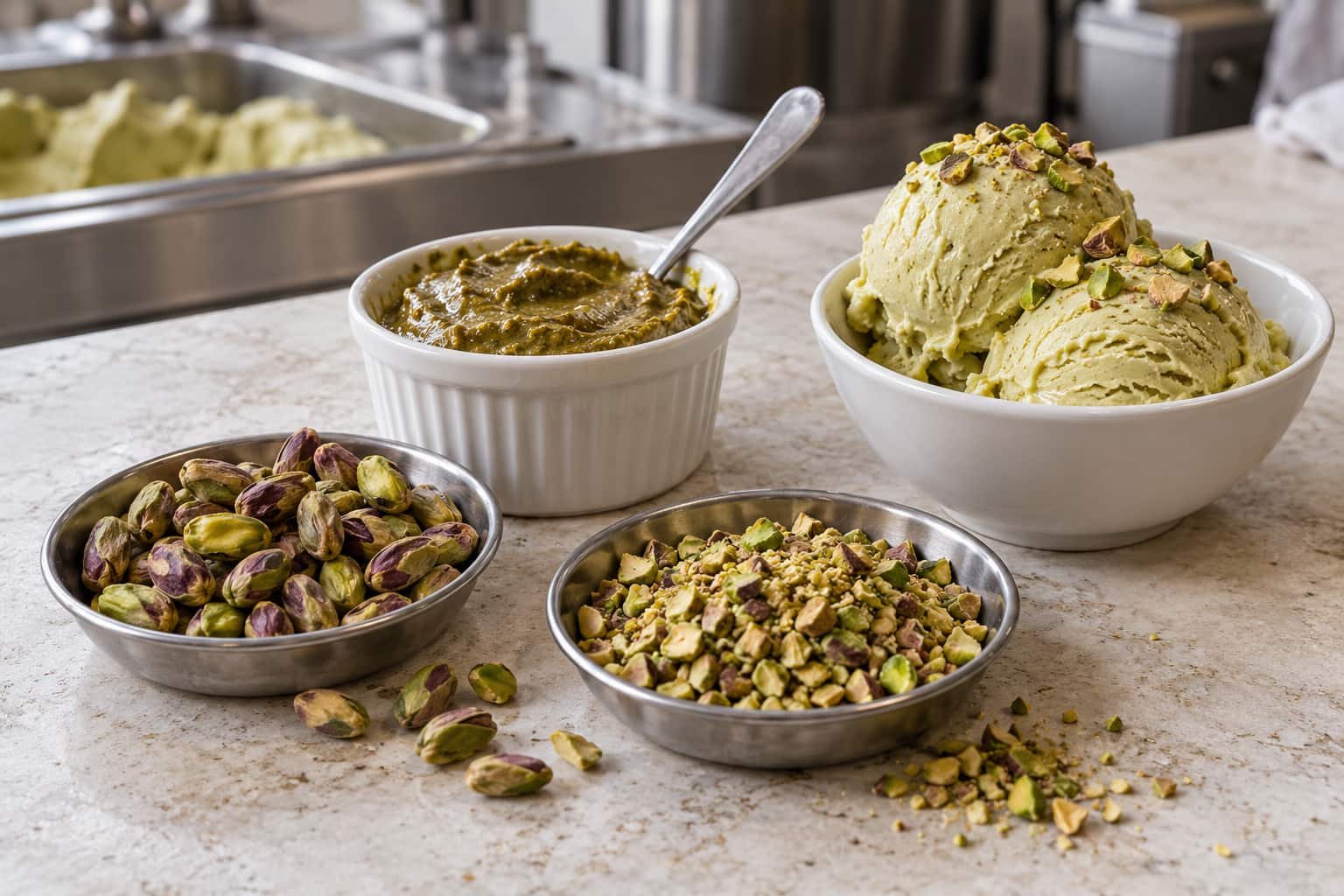
Before comparing suppliers, decide how the pistachio will enter your product Will you grind kernels into a paste? Add chopped pieces during production? Use whole kernels as a visible topping? Each application changes what you should buy.
A manufacturer may need more than one specification. The ingredient used to flavor an ice cream base does not have to be identical to the pistachios used for decoration.
Kernels for Grinding into a Smooth Base
When kernels will be ground, focus on their flavor and how they perform in your milling process.
Whole-kernel appearance may offer little value once the product becomes a paste. Suitable pieces can be worth evaluating if they meet the same freshness, food safety and processing requirements.
Evaluate whether your processing equipment can deliver the smoothness required for your ice cream or gelato. A successful kitchen trial does not necessarily reflect performance at production scale. When comparing ingredient options, our guide to pistachio paste vs pistachio cream explains how composition affects formulation decisions. Assess each option in the finished frozen product because its flavor and texture may change after blending and freezing.
Pieces for Texture Inside the Ice Cream
Pistachio pieces added to the product are often called inclusions For inclusions, agree on the particle-size range and the permitted amount of fines. Fines are the smaller particles produced during cutting and handling.
Evaluate how the pieces distribute through your equipment. Also check their texture after the finished product has been stored under its intended conditions A supplier’s description such as “chopped pistachios” is too broad for a precise production order.
Whole Kernels and Pieces for Decoration
Visible toppings create a different purchasing priority.
Here, color consistency, shape and presentation may justify a more selective grade. Even so, review the product in its actual serving format before paying for an appearance upgrade.
A large whole kernel may suit one presentation. Smaller pieces may provide better coverage for another.
| Application | Product Format to Evaluate | Main Buying Priority |
|---|---|---|
| Grinding for a smooth base | Whole kernels or suitable pieces | Flavor and milling performance |
| Texture within the product | Chopped or calibrated pieces | Particle distribution and stored texture |
| Visible decoration | Selected whole kernels or pieces | Appearance and portion consistency |
| Production using purchased paste | A clearly specified paste | Composition and formulation compatibility |
You can explore the bulk pistachio kernel range to compare available starting materials before requesting a quotation.
What Does “Grade” Actually Tell You?
A grade should help describe the ingredient. It should not replace a technical specification Commercial descriptions can refer to color, kernel integrity or a supplier’s own sorting system. Ask which system is being used and what the offered grade means in measurable terms.
Separate Color Grade from Product Quality
A color designation does not tell you everything about a batch. You still need information about freshness, defects, foreign material and the required food safety controls. A visually attractive sample cannot answer all those questions.
For context, USDA shelled-pistachio standards address drying, foreign material and several types of damage. These illustrate why quality assessment extends beyond color. They are not an automatic grading system for every Iranian supplier.
Define Whole Kernels, Splits and Pieces
Ask the supplier to describe the physical composition of the lot If your order is for whole kernels, agree on the expected whole-kernel percentage. For pieces, define the size range and assessment method.
Formal kernel standards can distinguish whole, split and mixed whole-and-broken classifications. Your purchase specification should make clear which description applies to the offered goods Do not use an in-shell size such as 20/22 as the complete specification for a kernel order. The product being measured is different once the shell has been removed.
Green Color Matters, but Judge It in the Finished Product
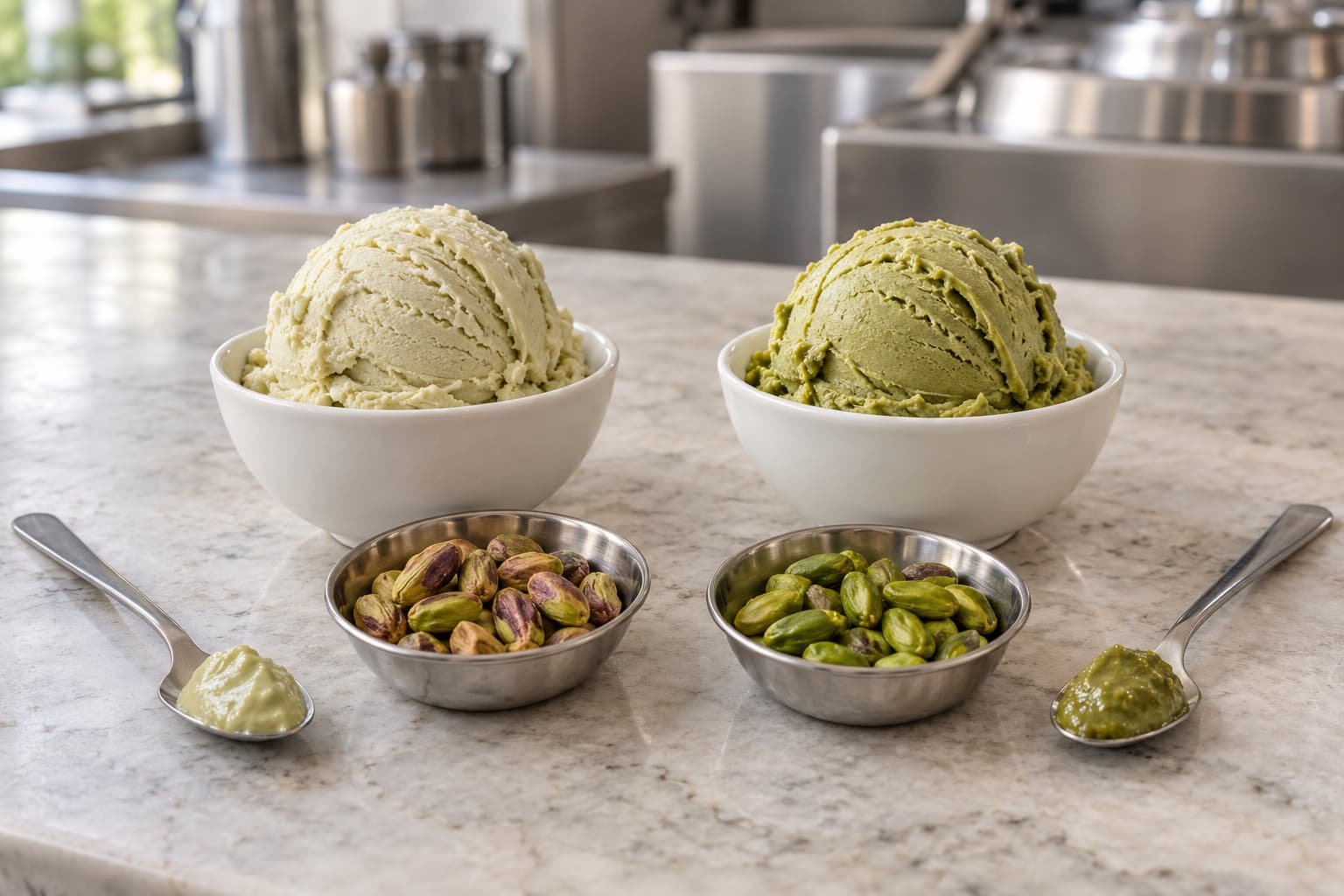
Pistachio color is part of the buying decision. It should be assessed under the conditions in which the ingredient will be used Compare samples under consistent lighting. Then review the color of the finished ice cream or gelato after the same preparation and storage process.
A photograph is useful for an initial discussion. It is not a reliable substitute for an approved physical sample.
Green Peeled and Early-Picked Are Different Descriptions
Green peeled pistachio kernels have had the outer kernel skin removed. Early-picked pistachios describe a harvest characteristic.
These terms should not be treated as interchangeable. RTF Nuts lists them separately and recommends confirming the required appearance through an agreed specification and representative sample.
When evaluating green peeled pistachio kernels, explain the color you need in the final product. Avoid ordering by a color name alone.
Test Whether a Color Upgrade Adds Enough Value
A greener ingredient may be commercially useful when appearance is central to your product positioning. In another formulation, the improvement may be too small to justify the additional cost Run comparable trials and document the result.
Use the same lighting when photographing samples. Keep the recipe and processing conditions consistent. This makes the comparison more useful for both purchasing and production teams.
Your decision should connect the extra ingredient cost to a visible or sensory improvement your customers value.
Raw vs Roasted Pistachio Kernels: Choose Through Trials
Raw and roasted kernels give you different processing options. Neither should be chosen purely because it sounds more premium If you buy raw kernels, determine who will perform any required treatment and processing. If you buy roasted kernels, agree on the roast profile and evaluate its consistency.
Commercial ingredient producers such as IRCA treat selection, roasting and grinding as connected decisions when developing pistachio ingredients for frozen applications.
When Raw Kernels May Suit Your Operation
Raw kernels may be worth considering when your facility needs control over the subsequent process Before purchasing, confirm that your equipment, staff and food safety system can support that plan. Include processing time and losses in your cost comparison.
“Raw” is a product description. It does not establish suitability for direct addition to a ready-to-eat product.
When Roasted Kernels May Be More Practical
A prepared roasted ingredient may reduce the amount of processing required at your facility Agree on how the roast will be described and assessed. Compare samples in the finished recipe rather than accepting a description such as “light roast” without a reference.
The American Pistachio Growers’ food-professional guidance discusses roasting for nuts used in ice cream and notes the importance of preserving color during that process. The appropriate result still needs to be evaluated in your own application.
Confirm Whether Salt or Other Ingredients Are Present
For straightforward formulation control, ask whether the supplied product contains salt, oil or other added ingredients An unsalted ingredient can be a useful starting point when the production team wants to control seasoning separately. A deliberately salted formulation may require a different specification.
Record the composition instead of assuming that all roasted kernels are prepared in the same way.
Whole Kernels, Powder or Paste: Compare What Your Equipment Needs
These formats are not direct substitutes without a production review Kernels require further handling if you need a smooth base. Powder has a defined particle distribution that may or may not meet your texture target. Paste needs a clear composition and consistency specification The best purchase depends partly on the processing work your business is equipped to perform.
Powder Needs a Particle Specification
Ask how the supplier defines “fine” and how particle size is checked If you are considering pistachio powder, trial it in your actual process. Check whether additional refining is needed to reach the intended mouthfeel.
Also confirm the ingredient composition. The product name alone should not be your only evidence of what it contains.
Pure Paste and Sweetened Cream Are Different Ingredients
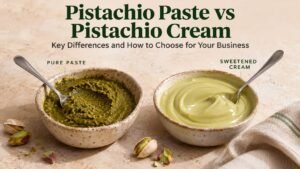
A product sold as pistachio paste may differ substantially from a sweetened pistachio cream or compound ingredient.
For example, Callebaut describes its pure pistachio paste as 100% pistachios with no added sweetening. Other products may have different formulations. Compare the actual ingredient lists and specifications before using them interchangeably.
A product containing sugar or other fats needs to be evaluated as part of the complete recipe. Its price per kilogram cannot be compared with kernels solely on the basis of its name.
Include the Cost of In-House Processing
If you make your own paste, the purchase price of kernels is only one component Record labor, energy, equipment time and processing losses. Include the checks needed to release each batch for use.
Purchased paste may simplify one operation. In-house processing may suit another. Compare the complete process against your required output before deciding.
Build a Specification Your Supplier Can Follow
A good specification helps a supplier quote the right product. It also gives your receiving team a reference for inspection Keep the requirements relevant to your application. Avoid requesting a long list of values without knowing how they will affect acceptance or production.
| Specification Area | What to Agree |
|---|---|
| Intended application | Grinding, inclusions, decoration or another defined use |
| Product form | Whole kernels, splits, pieces, powder or paste |
| Physical composition | Whole-kernel percentage or agreed size distribution |
| Appearance | Approved color reference and acceptable variation |
| Sensory characteristics | Agreed flavor and aroma reference |
| Processing | Raw, roasted or another specified treatment |
| Composition | Pistachio content and any added ingredients |
| Food safety | Applicable limits, treatment requirements and supporting evidence |
| Packaging | Net weight, food-contact material and sealing requirements |
| Traceability | Lot identification and relevant production information |
| Acceptance | Sampling, inspection and claims arrangements |
Use an Approved Sample as a Reference
Record the identity of the approved sample and the date it was assessed.
Ask whether it represents the offered commercial lot or a general product specification. Those are different types of approval For repeat purchasing, agree how future lots will be compared with the reference. Keep the written specification alongside the sample records.
Agree on Moisture and Water Activity Where Relevant
Moisture content and water activity, often written as aw, are different measurements Have your technical team determine which limits and methods are appropriate for the ingredient and intended process. Ask suppliers to report against those agreed requirements.
Avoid copying one moisture limit from an unrelated product sheet and treating it as a universal rule for every pistachio ingredient.
Check Food Safety Before Adding the Ingredient to Production
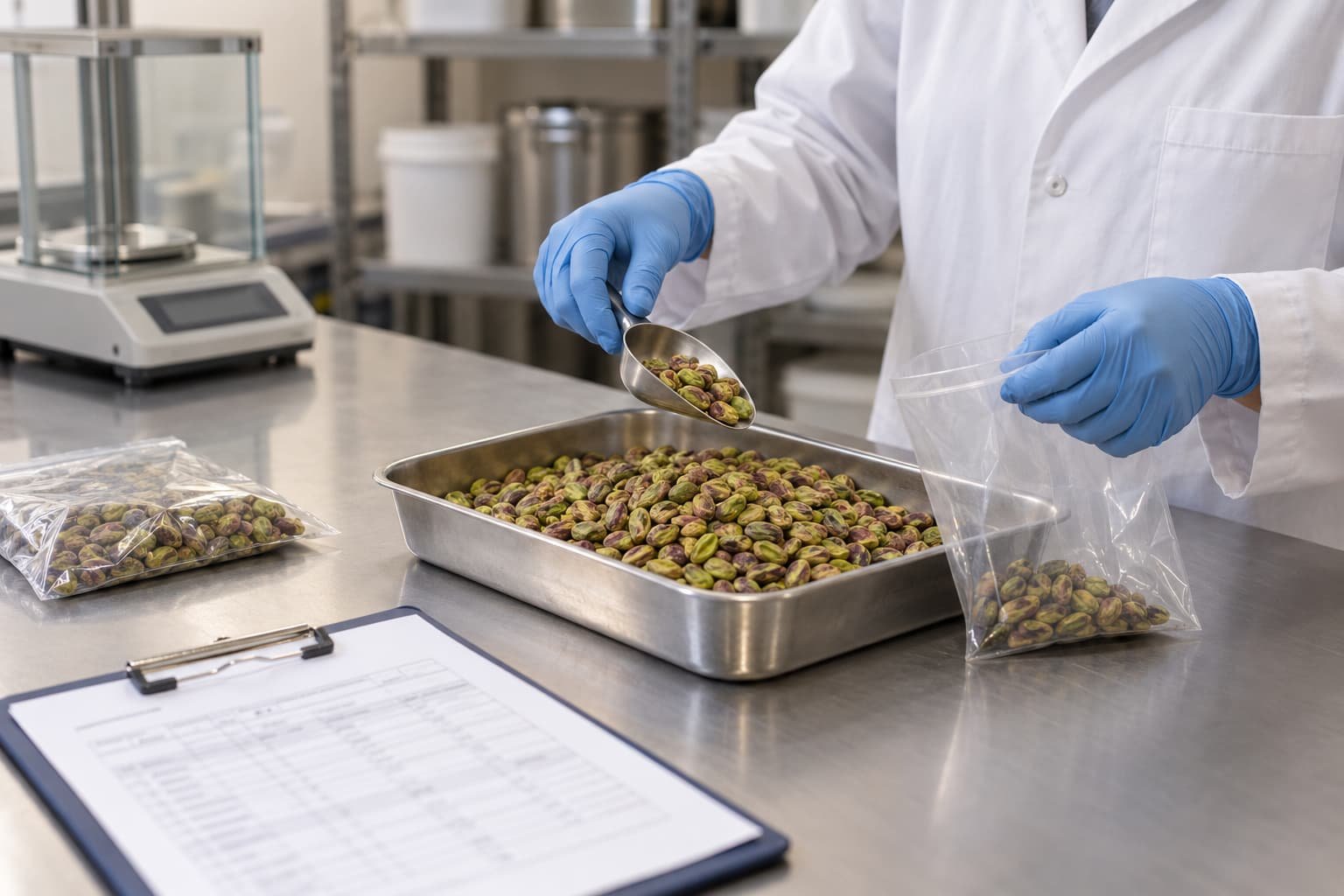
Food safety review should be proportionate to the product and its place in your manufacturing process.
FDA guidance specifically addresses Salmonella risks in foods containing pistachio-derived ingredients. Its scope includes raw and roasted kernels. For procurement, this supports reviewing the supplier’s controls rather than relying only on a visual inspection or a roast description.
Confirm the Ingredient’s Position in Your Process
Tell the supplier whether the pistachio will enter before or after a validated treatment stage This is particularly relevant for inclusions and toppings. Your food safety team should confirm whether the ingredient is suitable for its intended point of addition.
Do not assume that treatment of another component establishes the safety of the pistachio ingredient.
Review Lot-Specific Evidence
A Certificate of Analysis, or COA, should be checked for sample identity, reporting date and the tests it covers Agree the analytical requirements before shipment. Where independent testing or specific laboratory qualifications are required, make those conditions part of the order.
Our guide to pistachio quality control before export explains the broader relationship between inspection, documentation and traceability For destination-specific requirements, use the current rules for the actual market. A specification prepared for one country should not automatically be reused for another.
Compare Cost per Batch, Not Just Price per Kilogram
The cheapest pistachio kernels per kilogram may not give you the lowest cost for an acceptable finished product A useful comparison includes delivered ingredient cost and the quantity needed in a formulation that meets your approved sensory target.
Pistachio ingredient cost per batch = delivered ingredient cost per kilogram × kilograms used
If further processing is required, include those additional costs separately.
A Practical Cost Comparison
The following figures are hypothetical. They are not current RTF Nuts prices or recommended inclusion rates Assume two ingredients have been tested in separate formulations that achieve your team’s accepted result.
| Comparison | Ingredient A | Ingredient B |
|---|---|---|
| Delivered ingredient cost | $18/kg | $21/kg |
| Quantity used in a 100 kg finished batch | 6 kg | 5 kg |
| Pistachio ingredient cost per batch | $108 | $105 |
| Pistachio cost per kg of finished product | $1.08 | $1.05 |
In this example, the higher-priced ingredient has the lower cost contribution That conclusion is valid only if the finished products meet the required standard. A lower dosage is not an advantage when it produces an unacceptable result.
Keep Mass-Based and Volume-Based Costs Separate
For purchasing, a cost per kilogram calculation is usually straightforward If your business sells by volume, assess cost per liter using measured finished-product output. Overrun describes the increase in volume associated with air incorporation.
Avoid assuming that two recipes produce the same saleable volume simply because they begin with the same mix weight.
Test the Sample in Your Actual Ice Cream or Gelato
A supplier sample is the start of an evaluation. A controlled production trial turns it into useful purchasing evidence. Use a written trial sheet so that your team can compare results consistently.
Compare Samples Under the Same Conditions
For an initial comparison, keep the base recipe, ingredient quantity and processing method consistent where practical. Label samples with neutral codes. Record the results before discussing which supplier provided each one This helps reduce the influence of branding or an expected price difference on the assessment.
Review the Frozen Product, Not Only the Mix
Assess the product at its intended serving temperature Review flavor, mouthfeel and appearance after the normal production cycle. For inclusions, check distribution and texture.
Repeat the assessment after the intended storage period. A first-day result does not answer every question about the product your customer will receive.
Set Acceptance Criteria Before Choosing a Winner
Decide what constitutes an acceptable result before negotiating the final order. Your trial record might cover:
- Flavor and aroma
- Color in the finished product
- Smoothness or inclusion texture
- Performance through the production equipment
- Cost per accepted batch
A sample should meet both technical and commercial requirements. An ingredient that looks excellent but creates avoidable processing work may be unsuitable for your operation.
Which Iranian Pistachio Kernels Should You Evaluate?
Start with the required characteristics and then compare the available products The variety name gives useful background. It does not establish the complete specification or guarantee performance in your recipe.
Fandoghi Kernels for Application Trials
RTF Nuts lists Fandoghi pistachio kernels for food-processing applications including ice cream Request the available grade and physical format. Evaluate whether the offered lot meets your flavor, color and processing targets before choosing it on price.
Green Peeled or Early-Picked Options
When appearance is a priority, include suitable green peeled or early-picked options in your comparison.
State the application clearly. A sample for grinding into a base may need a different specification from a sample for visible decoration.
Evaluate the extra cost against the measured improvement. No single kernel type is automatically the best choice for every ice cream or gelato.
Packaging Should Fit Your Production Schedule
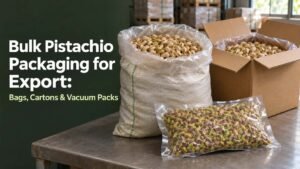
The most useful package size depends on how much ingredient you use once a pack is opened Compare packaging convenience with stock rotation, handling and your approved storage procedures. A larger pack may reduce packaging costs while creating more open-pack handling.
Ask for the supplier’s storage instructions and shelf-life information for the exact product.
Confirm Conditions for Opened Packs
An unopened-pack shelf life should not be treated as an automatic after-opening period.
Have your technical team establish how opened material will be identified, protected and used. Keep lot information connected to the ingredient throughout internal handling Where practical, use FEFO, or First Expired, First Out, to guide stock rotation according to the approved shelf-life records.
Buying for Russia: Keep Product Selection and Import Planning Connected
For Russian manufacturers and ingredient distributors, the first decision remains the same: select the product around the intended application.
Once a suitable specification is identified, confirm the import arrangements for that product. Processing state, packaging and intended use need to be communicated accurately to the importer and broker.
Our guide to importing Iranian pistachios into Russia covers the wider sourcing and shipment process.
Keep that work connected to purchasing. The product approved for production should be the product described in the order and shipment documentation.
Send an RFQ That Leads to a Useful Quotation
An RFQ, or Request for Quotation, should explain what you need the ingredient to do Instead of asking only for a pistachio kernel price, describe your application and required format. Include your estimated quantity and destination.
For repeat supply, share your expected purchasing schedule. This gives the supplier context when discussing current availability and future orders.
Information to Include in Your Inquiry
Provide the product form, processing requirements and relevant appearance or particle-size criteria. Add the packaging preference and required food safety documentation.
State the quantity per order and estimated monthly consumption where known.
Ask the supplier to identify the quotation currency, validity period, MOQ and delivery basis. MOQ means minimum order quantity. When using an Incoterm, include the named place so the scope of the quotation is clear.
Ask About Sample Availability Before a Bulk Order
If you need a production trial, explain the quantity of sample required and the tests you intend to run Confirm availability and dispatch arrangements before building the trial schedule around it For broader purchasing guidance, see our article on buying Iranian pistachios in bulk.
Frequently Asked Questions
What Are the Best Pistachio Kernels for Ice Cream?
The best option depends on the application For grinding, evaluate flavor and milling performance. For inclusions, focus on particle distribution and stored texture. For decoration, appearance may carry more weight.
Choose through representative samples and trials in your actual product.
Are Broken Pistachio Kernels Suitable for Gelato?
Suitable pieces may be worth considering when the ingredient will be ground Confirm their quality, size distribution and processing requirements. Physical breakage alone does not tell you whether a lot meets the full purchasing specification.
Do I Need Green Peeled Kernels?
They are an option when the exposed green appearance supports your product target Compare them with other suitable ingredients in the finished recipe. The additional cost should deliver a useful result.
Is Pistachio Powder the Same as Pistachio Paste?
No. They are different product forms Powder requires its own particle specification. Paste requires a composition and consistency specification. Check how either product fits your equipment and formulation.
How Much Pistachio Should I Use?
There is no single dosage suitable for every ingredient and recipe The amount needs to be established through formulation work and product trials. A pure paste and a compound ingredient should not be assumed to have the same recommended use level.
Can I Buy Pistachio Kernels in Bulk for Ice Cream Production?
RTF Nuts supplies pistachio kernels for commercial buyers. Available grades, quantities and packaging should be confirmed for your inquiry.
Describe the application and destination so the team can discuss appropriate options.
Find the Right Pistachio Ingredient for Your Next Production Run
A useful purchase starts with a clear application Decide whether you need kernels for grinding, pieces for texture or a product for decoration. Then compare samples against your flavor target, production requirements and cost per finished batch.
RTF Nuts can discuss available Iranian pistachio kernel options according to your specifications.
Contact RTF Nuts to discuss pistachio kernels for your ice cream or gelato production.
Send your required product form, estimated quantity and destination. If you need a production trial, ask about suitable grades and sample availability before placing a wholesale order.