For international pistachio buyers, quality control should begin long before a shipment leaves the producing country. A competitive price and attractive appearance are not enough to guarantee that a pistachio shipment will meet the buyer’s expectations or the destination market’s food safety requirements.
Export pistachios need to be evaluated from several perspectives, including variety, size, grade, moisture, appearance, taste, freshness, contamination risks, aflatoxin levels, packaging, storage conditions and documentation. For importers purchasing Iranian pistachios in bulk, having a clear quality control process can significantly reduce commercial risk and prevent problems after the shipment arrives.
Iran is one of the world’s important pistachio-producing countries, with several commercially valuable varieties such as Fandoghi, Ahmad Aghaei, Akbari and Kaleh Ghouchi. However, the quality of pistachios can vary depending on orchard conditions, harvest timing, processing methods, storage, grading and handling.
This guide explains the most important quality factors importers should check before purchasing and exporting Iranian pistachios.
Why Pistachio Quality Control Matters Before Export
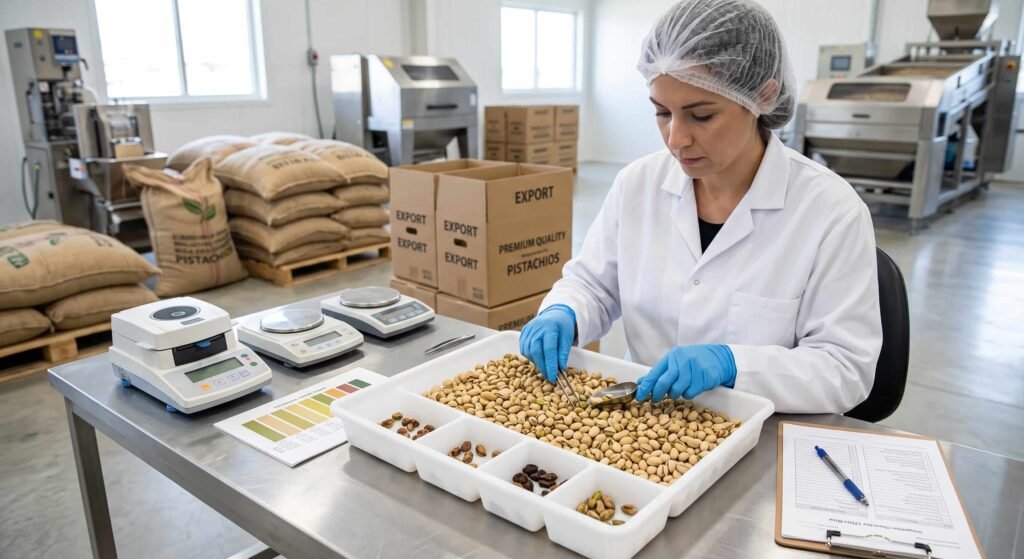
Pistachios are agricultural products, which means their quality can naturally vary between harvests, origins, suppliers and production lots. Even when two shipments have the same variety and grade, their actual quality may differ if they were processed or stored under different conditions.
For an importer, quality control is therefore more than checking whether the pistachios look good.
A professional quality control process helps verify that the product matches the agreed specifications and that it is suitable for transportation, storage, distribution, retail sale, or industrial use.
When importing Iranian pistachios, buyers need to ensure that the product matches the exact specifications agreed with the supplier. These specifications may include the pistachio variety, size, grade, moisture content, packaging format, and food safety requirements. Relying solely on the supplier’s description can create significant commercial and quality risks if these characteristics are not properly verified before shipment.
Pre-shipment inspection and laboratory testing can help confirm that the pistachios meet the agreed specifications and applicable food safety requirements. This is particularly important for exporters shipping to regulated markets such as the European Union, where food safety parameters must be carefully controlled. For example, buyers should pay close attention to aflatoxin testing and EU limits as aflatoxin levels can directly affect whether a shipment meets the applicable import requirements.
Without adequate verification, an importer may receive a shipment that technically contains pistachios but differs from the agreed commercial specifications or fails to meet the required safety standards. Establishing clear specifications and verifying them before shipment can therefore reduce disputes, rejected consignments, and unexpected costs.
Quality control is particularly important for large-volume purchases because a small percentage difference in defects or quality can represent a significant financial difference when multiplied across several tons.
Quality Control Protects Importers From Commercial Risk
Pre-shipment inspection gives buyers an opportunity to identify problems before the goods leave the origin country. Once a container has reached its destination, resolving quality disputes can become more complicated. Additional inspection, storage, customs clearance, return shipping, replacement shipments and commercial negotiations can all increase costs. A clearly defined quality control procedure helps reduce these risks.
Quality Is More Than Appearance
One of the most common mistakes among inexperienced buyers is judging pistachios primarily by appearance. A shipment may have an attractive color and uniform size while still requiring additional testing for moisture, contamination, aflatoxin, or other food safety concerns.
Professional pistachio procurement therefore combines physical inspection, sensory evaluation, laboratory analysis, documentation review and supplier verification.
What Does Pistachio Quality Control Include?
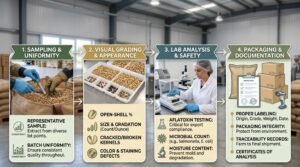
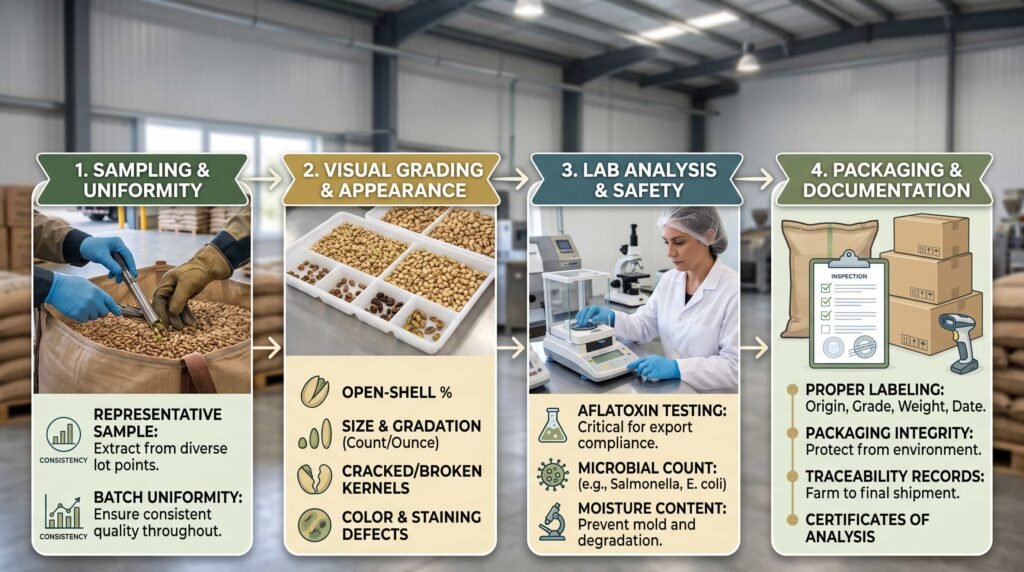
Pistachio quality control normally involves several stages, beginning with product specifications and continuing through inspection, laboratory testing, packaging and pre-shipment verification.
The exact inspection requirements depend on the product and destination market. However, a professional buyer should generally evaluate the following characteristics:
- Variety and origin
- Size and grade
- Open and closed shells
- Kernel appearance
- Color
- Moisture
- Taste and aroma
- Insect damage
- Mold and visible contamination
- Foreign materials
- Aflatoxin and other food safety parameters
- Packaging condition
- Storage conditions
- Lot traceability
- Export documentation
The purpose is not simply to reject defective products. The goal is to establish a consistent specification that both the supplier and importer understand before the purchase is finalized.
Key Factors to Check Before Buying Export Pistachios
Variety and Origin
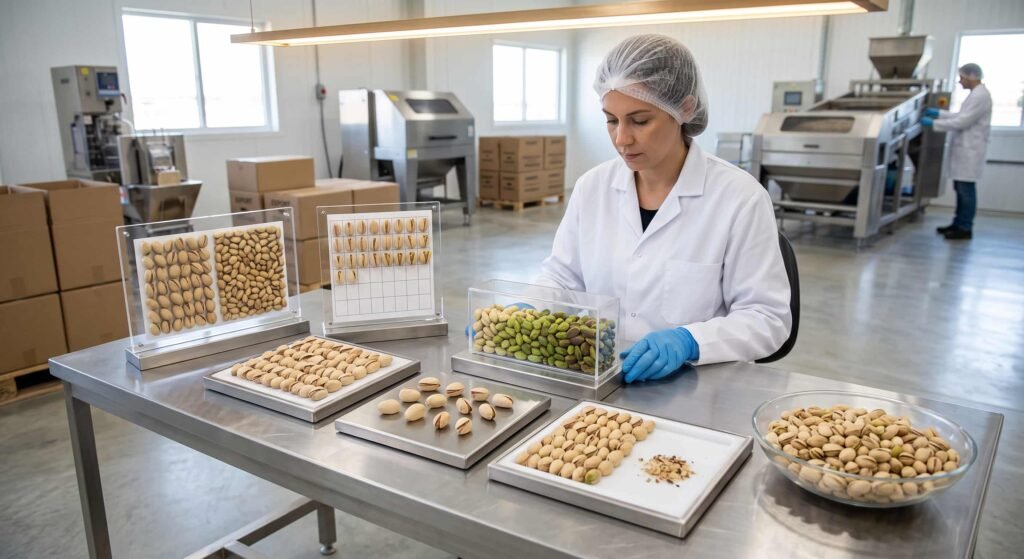
The first step in quality control is confirming exactly what product is being purchased. Iranian pistachios are commercially available in several varieties, each with different physical characteristics, market applications and price levels.
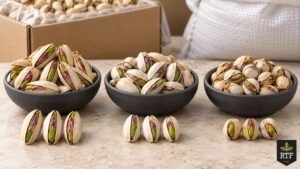
Fandoghi is one of the different types of pistachios recognized for its relatively round shape and widely used in various commercial applications. Ahmad Aghaei is typically identified by its elongated appearance and is particularly popular in premium markets. Akbari is a long pistachio variety associated with premium positioning, while Kaleh Ghouchi is distinguished by its larger, rounder appearance.
The variety should be clearly specified in the commercial agreement rather than relying only on photographs or informal descriptions. Importers should also confirm the origin and production lot where traceability is important.
Size and Grade
Size is one of the most important commercial characteristics of pistachios. In-shell pistachios are commonly evaluated according to the number of nuts per ounce or another agreed grading system. The exact classification can vary by market and supplier, so buyers should establish the grading methodology before placing an order.
For example, a buyer may request a particular size range because larger pistachios are intended for premium retail packaging, while smaller grades may be more suitable for food manufacturing. The important point is that the agreed size specification should be measurable and verifiable.
A professional purchase specification should not simply state “large pistachios.” It should define the expected grade, acceptable tolerance and inspection method.
Open and Closed Shells
For in-shell pistachios, shell opening is an important quality characteristic. Naturally open shells are generally considered desirable for many retail and snack applications because consumers can easily access the kernel.
However, the percentage of closed-shell nuts should be controlled according to the agreed product specification.
Buyers should also distinguish between naturally open pistachios and mechanically opened shells. These may have different commercial characteristics and should not automatically be treated as equivalent.
Kernel Quality
For shelled pistachios and pistachio kernels, quality control focuses heavily on the kernel itself. The buyer should examine:
- Kernel size
- Kernel color
- Kernel development
- Broken kernels
- Shrivelled kernels
- Discoloration
- Insect damage
- Mold
- Foreign materials
- Off odors
- Taste abnormalities
The desired characteristics depend on the end use. For example, a manufacturer producing pistachio paste may prioritize kernel yield and flavor, while a premium confectionery manufacturer may place greater importance on color, size and visual consistency.
Moisture Content
Moisture is another important parameter in pistachio quality control.
Excessive moisture can negatively affect product stability and may increase the risk of quality deterioration during storage. On the other hand, overly dry products can also have undesirable physical or sensory characteristics depending on the processing method and intended application.
Importers should therefore establish an acceptable moisture specification with the supplier and verify it through appropriate testing. Moisture should not be evaluated only by touching or visually examining the product. Instrumental measurement provides a more reliable basis for commercial quality control.
Color and Appearance
Appearance plays an important role in premium pistachio markets. For in-shell pistachios, buyers may examine shell cleanliness, color uniformity, staining, shell damage and overall presentation.
For kernels, color can be particularly important because green pistachio kernels are often used in premium food applications such as confectionery, desserts, ice cream, pastries and pistachio paste.
However, color alone should never be used as the only indicator of quality. A professional assessment considers color together with flavor, freshness, moisture, defects and food safety results.
Taste, Aroma and Freshness
Sensory inspection can reveal problems that are difficult to identify through visual inspection alone. A quality pistachio should have a characteristic fresh flavor and aroma. Unusual odors, rancid notes, excessive bitterness, or other abnormal sensory characteristics may indicate quality deterioration or inappropriate storage.
For larger commercial purchases, sensory evaluation should be performed on representative samples rather than relying on a single handful of pistachios.
Aflatoxin Testing and Food Safety
Aflatoxin is one of the most important food safety considerations in pistachio trade. Aflatoxins are naturally occurring toxins produced by certain molds under favorable environmental conditions. Because pistachios and other tree nuts can be susceptible to contamination, food safety testing is an important part of professional export quality control.
Importers should not assume that a product is safe simply because it looks clean. Aflatoxin contamination cannot reliably be identified through visual inspection alone. Laboratory analysis is required when testing is specified by the buyer, destination market, or applicable food safety requirements.
Why Aflatoxin Testing Matters
Aflatoxin requirements can differ depending on the destination market, product category, intended use and applicable regulations. For this reason, importers should identify the requirements that apply to their market before finalizing the purchase specification.
For shipments entering regulated markets, the importer may need laboratory documentation demonstrating compliance with the applicable maximum levels. This is especially important when importing pistachios for direct human consumption.
Laboratory Testing Should Be Representative
Sampling is a critical part of food safety testing. A laboratory result is meaningful only when the sample represents the shipment or lot being evaluated. Poor sampling can produce misleading results even when the laboratory analysis itself is technically correct.
For large commercial shipments, importers should work with qualified laboratories and appropriate sampling procedures rather than testing a small, convenient sample chosen without a defined methodology.
How to Inspect Iranian Pistachios Before Shipment
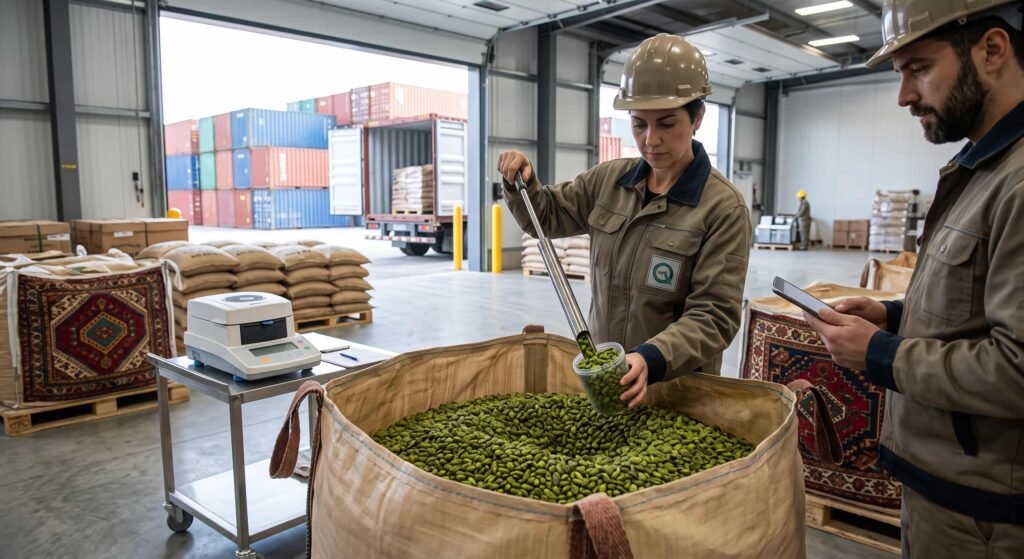
A professional pre-shipment inspection should be based on the agreed product specification. Before the goods are loaded, the buyer or an independent inspection company can examine representative samples from the relevant lot.
The inspection should compare the actual product against the contractual requirements. For example, if the purchase agreement specifies Iranian Ahmad Aghaei pistachios in a particular size grade, the inspection should confirm the variety, size distribution, physical condition, defects, moisture, packaging and required laboratory results.
The inspection should also verify that the product being loaded corresponds to the tested and approved lot. This point is important because testing one sample and subsequently shipping a different production lot creates unnecessary risk.
Pre-Shipment Inspection
Depending on the transaction, inspection may be performed by the buyer, supplier, third-party inspection company, or a combination of these parties.
The scope can include:
- Product identity
- Quantity
- Size and grade
- Physical defects
- Packaging
- Labeling
- Moisture
- Sensory characteristics
- Laboratory certificates
- Lot identification
- Container condition
The exact inspection scope should be agreed before shipment rather than after a problem occurs.
Laboratory Testing for Export Pistachios
Laboratory testing can provide objective information that cannot be determined through visual inspection alone. The testing program depends on the buyer’s requirements and destination market, as well as factors such as in-shell vs shelled pistachios but may include food safety and quality parameters relevant to pistachios. A professional importer should ask the supplier which tests have been performed and request the corresponding reports when appropriate.
Choosing a Laboratory
The laboratory should be appropriately qualified for the tests being requested. Importers should pay attention to:
- Laboratory identity
- Testing date
- Sample identification
- Lot or batch number
- Test methods
- Results
- Applicable limits or specifications
- Accreditation or qualification where relevant
A laboratory report without clear sample identification is less useful for shipment traceability.
Pest, Mold and Contamination Checks
Pistachios should be inspected for visible signs of insects, mold, unusual discoloration, foreign materials and other contamination. Pest-related problems can create both commercial and regulatory difficulties.
Importers should also consider the condition of the shipment environment. Packaging can protect the product, but it cannot compensate for poor-quality pistachios or unsuitable storage conditions. The product should be stored and transported under conditions appropriate for maintaining its quality.
Packaging and Storage Quality Control
Packaging is an important part of export quality because pistachios may travel significant distances before reaching the final buyer. The packaging format should be selected according to the product, shipping method, storage period, destination market and buyer’s requirements.
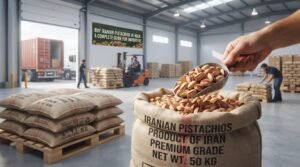
Bulk pistachios may be supplied in large commercial bags or other appropriate food-grade packaging, while retail products may require smaller consumer packages with specific labeling requirements.
Packaging Materials
Packaging should protect the pistachios from environmental factors that can negatively affect quality. The buyer should verify that the packaging is:
- Food suitable
- Clean and intact
- Properly sealed
- Appropriate for the product
- Suitable for transportation
- Properly labeled
The packaging should also make it possible to identify the relevant lot or batch when traceability is required.
Storage Conditions
Storage conditions can have a significant effect on pistachio quality. Pistachios should be protected from excessive heat, moisture, contamination, pests and unsuitable storage environments.
Importers should ask suppliers how the product was stored before shipment and whether the storage conditions were appropriate for maintaining the product’s quality.
For long-distance international trade, storage history becomes particularly important because the product may spend considerable time in warehouses, ports, transit facilities and distribution centers.
Export Documentation and Traceability
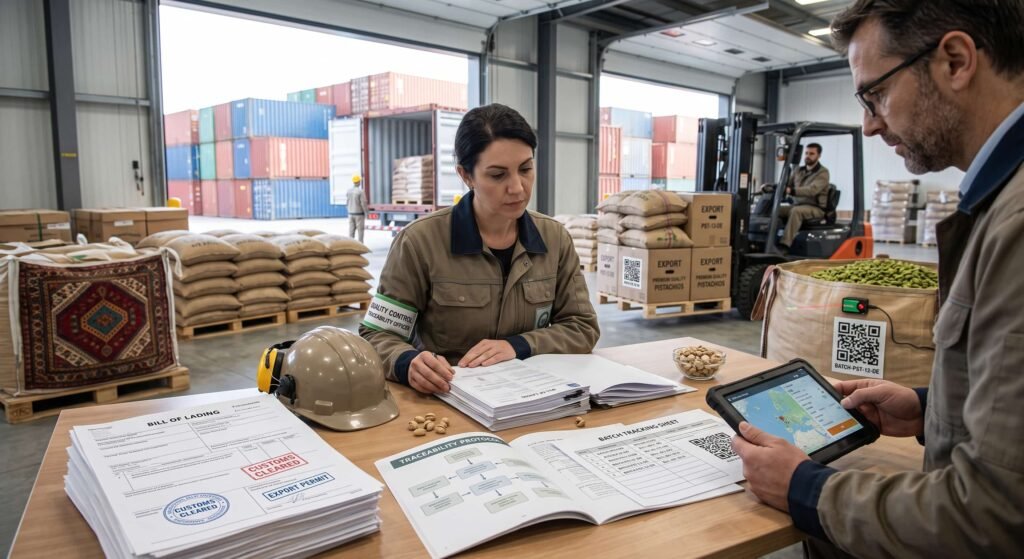
Quality control does not end with the physical product. Documentation is an important component of international food trade because it allows buyers to verify what was purchased, where it came from and which tests or controls were performed.
Depending on the transaction and destination market, documentation may include commercial invoices, packing lists, certificates of origin, phytosanitary documentation, laboratory reports, certificates requested by the buyer and other export or customs documents.
The exact documents required should always be confirmed for the destination country and product.
Lot Traceability
A reliable supplier should be able to identify the relevant production or processing lot. Traceability helps connect the physical product with its inspection records and laboratory results.
For example, if a laboratory report refers to Lot A123, the buyer should be able to verify that the pistachios loaded into the container correspond to that same lot or to an appropriately documented production batch.
This becomes especially important when dealing with food safety investigations or commercial disputes.
What Importers Should Request From a Pistachio Supplier
Before placing a large order, importers should request enough information to evaluate the supplier and product. Rather than asking only for a price, buyers should discuss the complete product specification.
A professional supplier should be able to explain the variety, grade, origin, processing method, packaging, available quality documentation and expected specifications. The importer should also ask for representative samples before committing to a large commercial shipment.
Product Samples
Samples allow buyers to evaluate the actual product rather than making a purchasing decision based entirely on photographs or descriptions. The sample should represent the product that will eventually be shipped. If the commercial order is significantly larger than the sample quantity, the buyer should establish how consistency between the approved sample and the final shipment will be controlled.
Product Specification
The purchase specification should clearly define the characteristics that matter commercially. This may include variety, size, grade, moisture, defect tolerance, packaging, food safety requirements and other agreed parameters. The more clearly the product is defined, the easier it becomes to inspect the shipment and resolve potential disagreements.
Common Quality Problems Importers Should Avoid
Some quality problems are relatively easy to prevent when buyers establish proper controls from the beginning.
Buying Based Only on Price
The lowest quotation is not necessarily the lowest total cost. A cheaper shipment may have higher defect rates, inconsistent grading, inadequate documentation, or additional costs associated with inspection, storage, rejection, or reprocessing.
Importers should compare suppliers based on total commercial value rather than unit price alone.
Relying Only on Photos
Photos are useful for preliminary evaluation, but they cannot verify many important quality parameters. A photograph cannot confirm moisture, aflatoxin levels, laboratory results, internal kernel quality, or the complete distribution of defects within a shipment.
Samples and objective testing are therefore essential for serious commercial purchases.
Failing to Define Tolerances
Natural agricultural products will rarely be perfectly uniform. The commercial agreement should therefore establish reasonable tolerances for parameters such as size variation, defects, closed shells, broken kernels, or other relevant characteristics.
Without agreed tolerances, even a minor difference between the buyer’s expectation and the supplier’s interpretation can become a dispute.
Testing the Wrong Lot
Another important risk is using laboratory results that do not correspond to the actual shipment. Buyers should verify the relationship between laboratory reports, lot numbers, production batches and the goods loaded for shipment.
How to Evaluate an Iranian Pistachio Supplier
Choosing the right supplier is one of the most important parts of quality control. A professional Iranian pistachio exporter should be able to provide clear information about its products, sourcing, processing, quality control procedures, packaging and export experience.
The buyer should evaluate the supplier’s ability to deliver consistent quality rather than focusing exclusively on the first sample.
Supplier Experience and Product Knowledge
A knowledgeable supplier should be able to explain the differences between Iranian pistachio varieties and recommend suitable products based on the buyer’s market and application. For example, a supplier serving a premium snack market may recommend a different variety and grade than a supplier serving a food manufacturer.
This level of product knowledge is an important indicator of export competence.
Consistency Between Orders
One good shipment does not necessarily prove that a supplier can provide consistent quality over time. Long-term buyers should evaluate whether the supplier can maintain agreed specifications across multiple lots and harvest periods. Consistency is particularly important for wholesalers, distributors, private-label brands and food manufacturers.
Quality Control for Different Pistachio Products
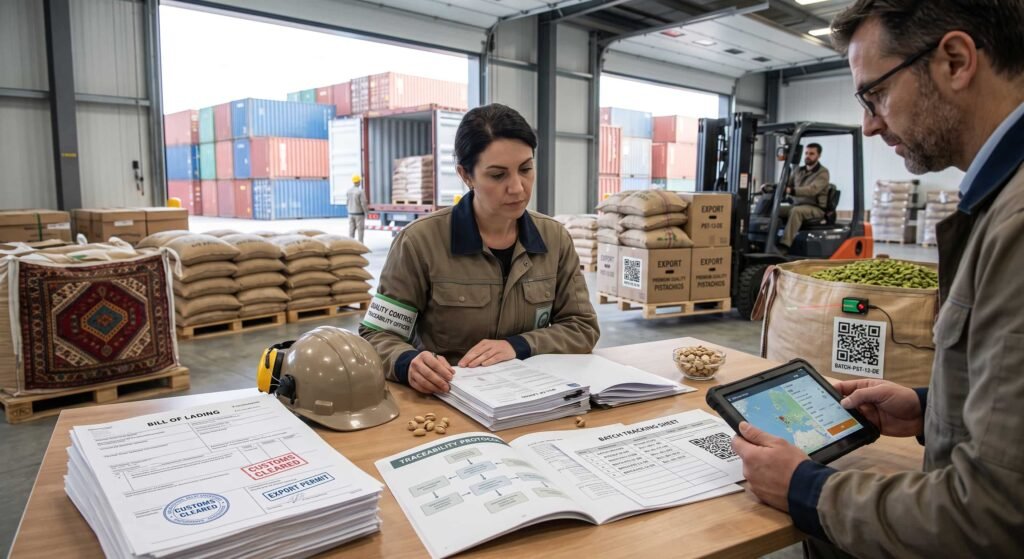
Quality requirements can change depending on the form of the pistachio.
In-Shell Pistachios
For in-shell pistachios, importers may focus on shell appearance, size, natural shell opening, closed shells, cleanliness, defects and overall presentation. Premium retail products often require stricter visual consistency because the consumer sees the entire product.
Shelled Pistachios
For shelled pistachios, kernel quality becomes more important. Buyers may evaluate kernel size, color, shape, broken pieces, moisture, flavor and contamination. The end application should determine which characteristics receive the greatest weight.
Pistachio Kernels for Industrial Use
Industrial buyers may have specifications that differ from retail buyers. For example, a manufacturer producing pistachio paste, fillings, confectionery, ice cream, bakery products, or other foods may prioritize yield, flavor, color and processing characteristics rather than visual perfection.
The supplier should therefore understand the buyer’s intended application before recommending a product.
Final Pre-Shipment Quality Checklist
Before an Iranian pistachio shipment leaves the country of origin, importers should verify that the product matches the agreed commercial specification. The buyer should confirm the variety and grade, inspect representative samples, verify size and defect tolerances, review moisture results, assess sensory quality and confirm that the required food safety testing has been completed.
Packaging and labeling should also be checked before loading.
The laboratory documentation should correspond to the relevant product lot and the commercial and export documents should contain consistent product information. Finally, the importer should verify the loading condition and ensure that the shipped goods correspond to the approved sample and specification.
Why Quality Control Is Important for Long-Term Pistachio Imports
For a one-time transaction, quality control helps reduce immediate commercial risk. For long-term importers, it plays an even more important role. A reliable quality control system creates a common language between the buyer and supplier.
Instead of discussing quality in subjective terms such as “good,” “premium,” or “large,” both parties can work with measurable specifications.
This makes procurement more predictable and allows the importer to compare different suppliers using consistent criteria. For companies importing Iranian pistachios regularly, quality control can also support better forecasting, inventory management, customer satisfaction and supplier relationships.
The strongest supplier relationships are generally built on consistency and transparency. When both sides understand the product specification and inspection process, there is less room for misunderstanding.
How RTF Nuts Supports Pistachio Quality for International Buyers
For international buyers, sourcing pistachios is not simply about finding a supplier with competitive prices. The objective is to receive a product that matches the agreed specifications and is suitable for the intended market.
RTF Nuts focuses on supplying Iranian pistachios for international buyers with attention to product variety, commercial specifications, quality control, packaging and export requirements.
Depending on the buyer’s requirements, Iranian pistachios can be sourced in different varieties and product forms, including in-shell pistachios and pistachio kernels.
For importers purchasing in bulk, discussing the target market, application, required grade, packaging format and quality specifications before finalizing an order can help create a more reliable procurement process.
Conclusion
Pistachio quality control before export is an essential part of international sourcing. Importers should evaluate much more than appearance and price. Variety, size, grade, moisture, kernel quality, shell condition, freshness, contamination, aflatoxin, packaging, storage, documentation and traceability can all influence the value and suitability of an export shipment.
For buyers of Iranian pistachios, the best approach is to establish clear specifications before purchasing, evaluate representative samples, use appropriate laboratory testing, verify documentation and inspect the final shipment before loading whenever practical.
A reliable quality control process protects the importer while also helping suppliers maintain consistent standards.
For companies looking to build a long-term supply relationship, consistency is ultimately one of the most valuable characteristics of an Iranian pistachio supplier. By combining clear specifications, proper testing, professional inspection and transparent communication, importers can significantly reduce risk and make better purchasing decisions in the international pistachio market.