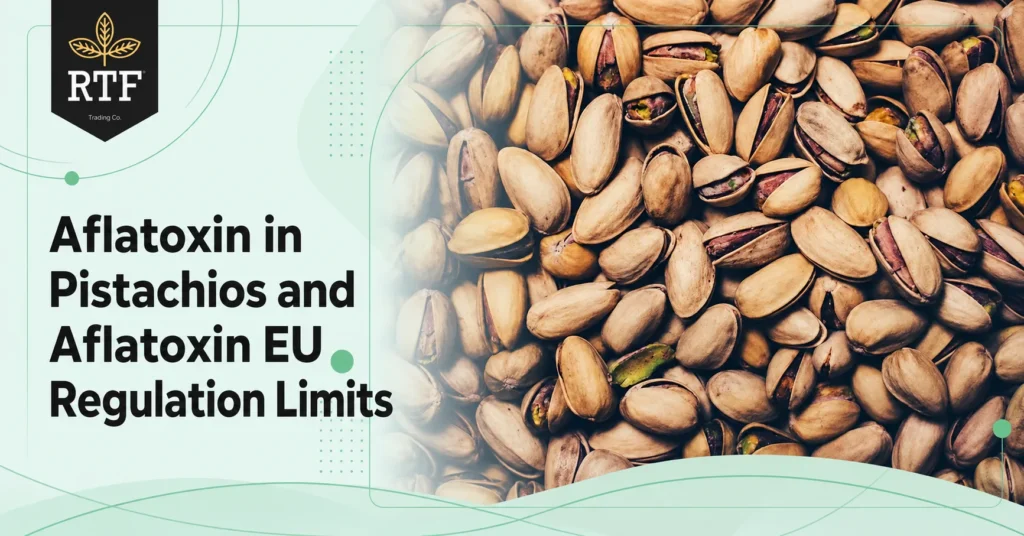
Aflatoxin is no longer a laboratory parameter for European pistachio importers. It may impact approval of suppliers, specifications, import documentation, official controls and commercial acceptance of a shipment. A very good looking lot of pistachios can be an excellent appearance, an appropriate kernel size, colour and commercial grade and still need to be lab verified for the presence of aflatoxin in pistachios.
Buyers’ questions are practical: How does contamination happen? What are the limits in the EU? How would this representative sample be analysed? What are the rules of Iranian pistachios? What analytical data would the supplier provide before a shipment?
This guide provides the answers to those questions from a European importer’s point of view, and sets out how RTFS Nut handles pre-export aflatoxin testing and laboratory documentation.
Aflatoxin in Pistachios and Key Facts
| Key Question | Answer |
| What is the EU limit for Aflatoxin B1 in pistachios? | 8 µg/kg (8 ppb) for direct consumption or use as a food ingredient |
| What is the EU limit for total aflatoxins? | 10 µg/kg (10 ppb) for direct consumption or use as a food ingredient |
| What limits apply before sorting or further physical treatment? | 12 µg/kg B1 / 15 µg/kg total aflatoxins |
| Which aflatoxins are normally measured? | B1, B2, G1, and G2 |
| How are pistachios tested? | Representative sampling followed by validated laboratory analysis |
| Are Iranian pistachios subject to specific EU controls? | Yes |
The pistachio-specific maximum levels are set out in Commission Regulation (EU) 2023/915.
Do Pistachios Have Aflatoxin?
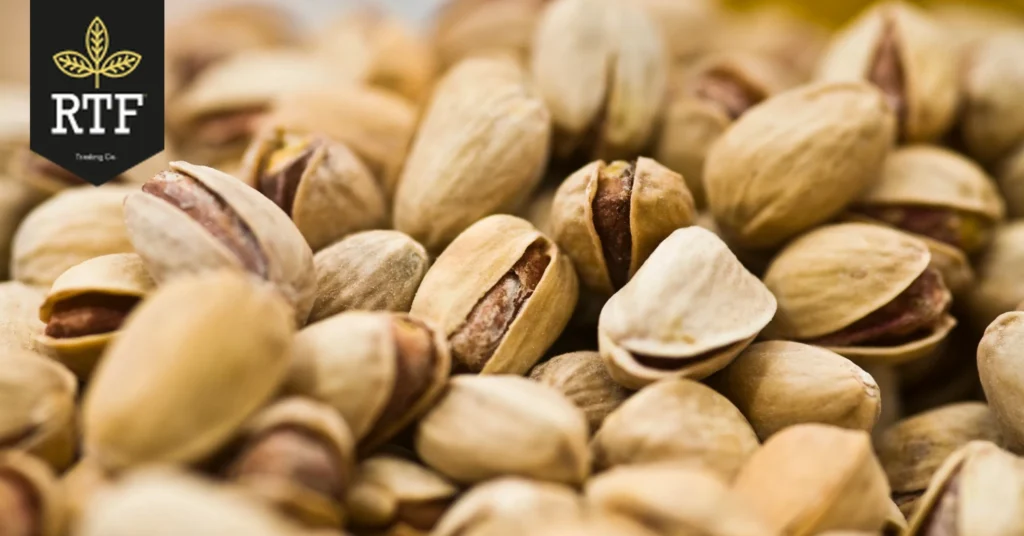
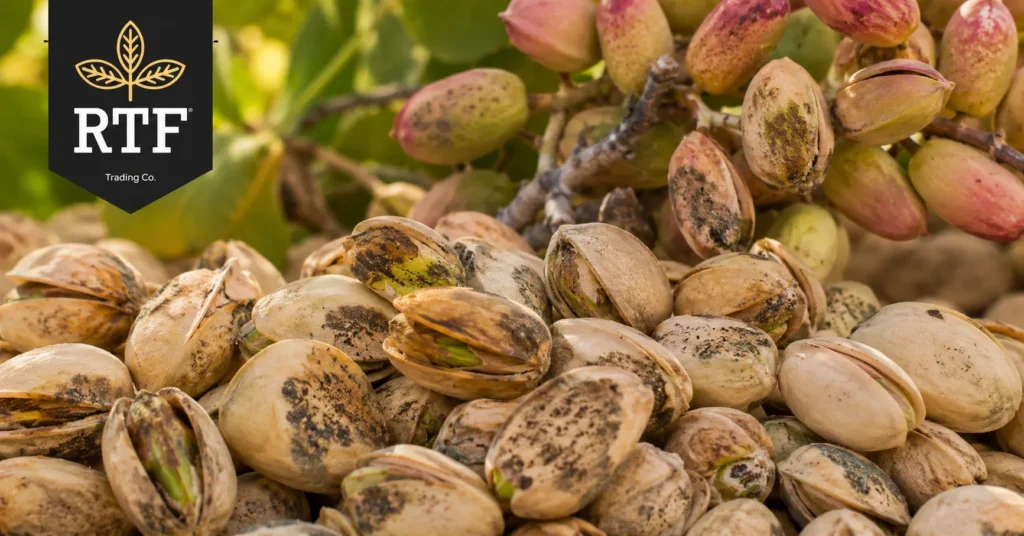
Yes, a natural occurring risk in pistachios that is made by fungi that can infect the nut in the field, particularly if it is split early or damaged by insects. This doesn’t imply that all pistachios or shipments are tainted with unsafe amounts, and it is usually not apparent from the exterior. The true question of whether pistachios can be contaminated with aflatoxin is not whether they are contaminated, but whether the particular lot that has been properly sampled and tested for the contamination limits is within the specific limits for that lot.
What Is Aflatoxin in Pistachios?
Aflatoxins are naturally occurring mycotoxins produced mainly by certain species of Aspergillus fungi, including Aspergillus flavus and Aspergillus parasiticus.
The four aflatoxins most relevant to pistachio testing are:
- Aflatoxin B1
- Aflatoxin B2
- Aflatoxin G1
- Aflatoxin G2
Of these, Aflatoxin B1 (AFB1) is a particular concern for regulation due to its toxicological importance. European legislation, therefore, establishes a maximum value for AFB1 and another for total aflatoxins (B1 + B2 + G1 + G2).
This is important when looking at a test report. The individual AFB1 result and the total-aflatoxin concentration should be considered, not a general “pass” statement.
How Does Aflatoxin Develop in Pistachios?
Sometimes, aflatoxin contamination is referred to as a storage issue, but the risk may start as early as in the supply chain:
Orchard → Early split or damage → Harvest → Post-harvest handling → Drying → Storage → Shipment
Before harvest
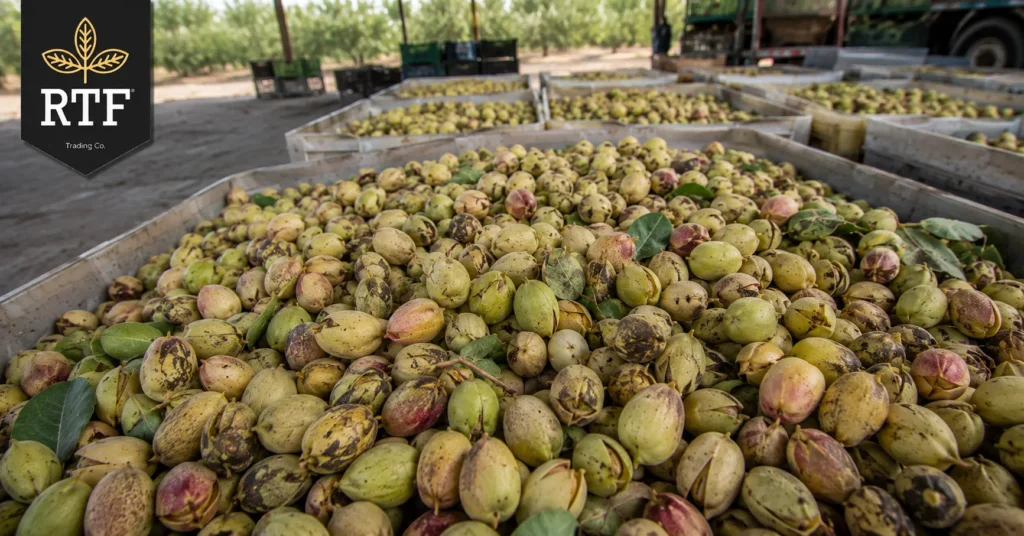
The fungi which produce the aflatoxin are naturally present in the agricultural areas. Once the natural protective shell has been broken, pistachios become more susceptible; an early split will allow insects and fungal spores to penetrate before the normal time of harvest. Fungal infestation is also more prevalent in the areas already damaged by insects.
Harvest and post-harvest handling
It is important to identify the best harvest time and manage post harvest operations effectively. Maturity is the time of the year when pistachio harvesting and processing should begin. Fresh pistachio nuts contain more moisture than dried nuts, and the longer the time between harvest and hulling and drying increases the risk of fungal growth.
Drying
One of the most critical preventive steps is the proper drying. Dry looking nuts are not quite dry enough, and fungal growth and toxin production should be reduced by lowering the moisture and water-activity appropriately. Early post-harvest management and moisture control are mentioned in both the FAO and the Codex guidance for Pistachio.
Storage
Risk management does not stop after the drying process! The following should be avoided in storage: Condensation, moisture migration, excessive humidity, poor ventilation, pest activity, and unsuitable warehouse conditions. Even if it is a well processed lot, it may further deteriorate in the supply later.
Which Pistachios Require More Attention?
| Risk Factor | Why It Matters |
| Early-split pistachios | Kernel exposed earlier to insects and fungal contamination |
| Insect-damaged nuts | Physical damage provides easier access for fungi |
| Delayed post-harvest handling | Extends exposure to favourable moisture and temperature conditions |
| Inadequate drying | Leaves conditions more favourable for fungal activity |
| High-humidity storage | Can reintroduce moisture after drying |
| High levels of defective nuts | May indicate a larger proportion of higher-risk material |
Sorting can reduce risk by removing visibly damaged or defective nuts, but it cannot guarantee that a lot complies with aflatoxin limits — contamination is not always visible, which is why laboratory analysis remains necessary.
EU Aflatoxin Limits for Pistachios
EU aflatoxin limits for pistachios depend on the intended use of the product. Commission Regulation (EU) 2023/915 classifies pistachios into those entering into the consumer food chain and those which are to be further sorted or are to be physically treated.
Pistachios for direct consumption or use as a food ingredient
| Product Category | Aflatoxin B1 | Total Aflatoxins |
| Direct human consumption / food ingredient | 8 µg/kg (8 ppb) | 10 µg/kg (10 ppb) |
Pistachios intended for sorting or further physical treatment
| Product Category | Aflatoxin B1 | Total Aflatoxins |
| Sorting / further physical treatment before final consumer use | 12 µg/kg (12 ppb) | 15 µg/kg (15 ppb) |
This distinction should be reflected in the buyer’s purchasing specification. Writing only “EU-compliant pistachios” leaves too much room for interpretation. A stronger B2B specification should identify: intended product use, maximum permitted AFB1, maximum permitted total aflatoxins, testing requirements, and relevant laboratory documentation.
Aflatoxin EU Regulation Limits, Why Do You See 2/4 and 8/10 Online?
One common source of confusion around aflatoxin EU regulation limits is the appearance of different numbers on different websites, e.g., 2 µg/kg AFB1 / 4 µg/kg total aflatoxins.
This is because EU legislation has specific limits for tree nuts of various types. Pistachios are specified separately: The limits for AFB1 and total aflatoxins are 8 µg/kg for use as a food for the final consumers and 10 µg/kg for use as a food ingredient. Note: Do not assume the generic 2/4 figures that are currently applied to some other nut categories are applicable to pistachios.
Previously, the safest method for procurement teams was to look at the specific product category listed in the current EU Regulation, and not an ambiguous online search for “nuts.”
Why Sampling Is Critical in Aflatoxin Testing
Much of the aflatoxin testing occurs before the laboratory instrument is even switched on. The contamination may be unevenly distributed in a commercial lot – a few contaminated nuts could be clustered in a small area of a large shipment. A handful of samples may thus give an inaccurate result for the entire consignment. One of the most basic rules of pistachio aflatoxin analysis is that a very accurate lab technique can’t fix an inaccurate sample.
Commission Implementing Regulation (EU) 2023/2782 lays down the official sampling and analytical methods for mycotoxin control in food. The number of incremental samples depends on the lot and sampling procedure and are usually collected from various areas of the lot and then mixed prior to preparation for the laboratory. In Europe, sampling should not have to undergo customs clearance as a separate process; it should be considered a part of supplier verification and not just a formality.
What Is the Procedure for Analyzing Aflatoxins in Pistachios?
Once a representative sample has been collected, testing generally follows three stages:
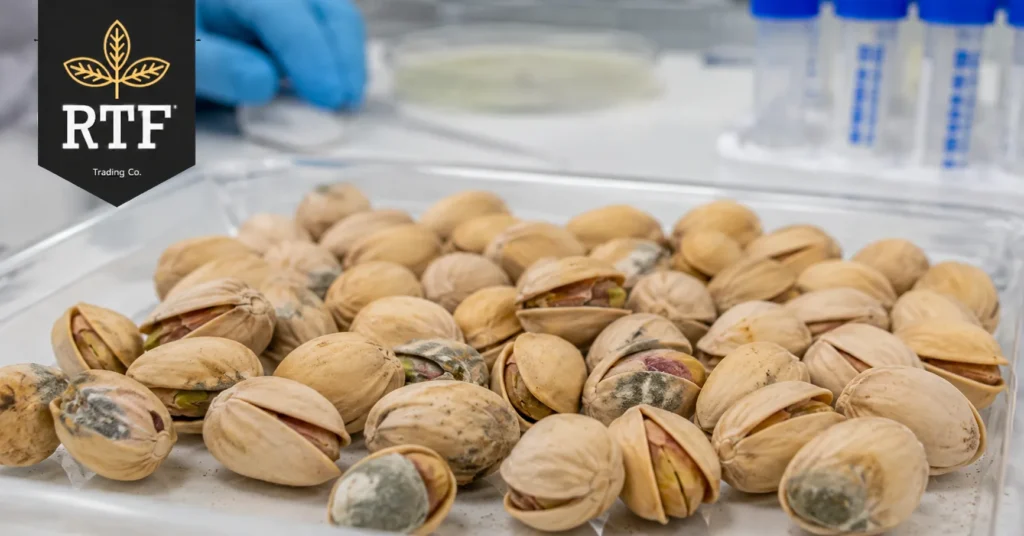
- Sample preparation. The laboratory prepares and homogenises the sample. Homogenisation matters particularly for pistachios, since contamination can vary considerably between individual nuts — the goal is to make the analytical portion represent the submitted sample as closely as possible.
- Analytical testing. Several methods can be used, depending on the laboratory, the purpose of testing, required sensitivity, and the quality-management system in place:
| Method | Typical Use |
| ELISA | Screening or routine immunoassay-based analysis |
| HPLC | Quantitative determination of individual aflatoxins |
| LC-MS/MS | Sensitive quantitative analysis and multi-mycotoxin workflows |
ELISA is useful for relatively fast screening when a lab needs to process multiple samples efficiently. HPLC (High-Performance Liquid Chromatography) is widely used for quantitative determination of individual compounds such as B1, B2, G1, and G2. LC-MS/MS (Liquid Chromatography–Tandem Mass Spectrometry) offers higher sensitivity and is useful when several mycotoxins need to be analysed in the same workflow. These are typical applications, not an official EU ranking of methods — what matters for regulatory purposes is that the method is appropriate for its purpose and meets applicable validation requirements.
- Result interpretation. The result is assessed against the agreed specification. Two values matter most: Aflatoxin B1, and Total Aflatoxins (B1 + B2 + G1 + G2). The legal limit that applies depends on the intended use of the product.
Aflatoxins EU Regulation, What Applies to Iranian Pistachios?
The maximum limits of aflatoxins in EU regulation are not the most significant piece of the puzzle when buyers look into aflatoxins EU regulation.
Iranian in-shell and shelled pistachios are still in the European Union framework of specific official controls on the presence of aflatoxins (Commission Implementing Regulation (EU) 2019/1793 as amended Commission Implementing Regulation (EU) 2019/1793 ). This is not just a simple case of checking a lab result against the legal maximum for European importers.
Depending on the applicable rules for the exact commodity and consignment, requirements may involve:
- EU entry documentation.
- sampling and analytical documentation;
- official certification;
- documentary checks;
- identity or physical checks;
The EU’s TRACES platform is available to assist official certification and import-control processes. The Common Health Entry Document for relevant consignments of food and feed of non-animal origin is CHED-D.
The requirements of Regulation 2019/1793 are subject to changes from time to time and buyers should check the current requirements before each shipment instead of relying on an old specification, supplier statement or article.
What Should a European Importer Ask a Pistachio Supplier?
A buyer doesn’t need to become a laboratory specialist, but a few questions reveal a lot about a supplier’s approach to quality control. Before approving a shipment, ask:
- Is the export lot tested for aflatoxins before shipment?
- Can you provide the laboratory report for this specific product or lot?
- How was the laboratory sample obtained from the commercial lot?
- Can the analytical result be traced to the pistachios being shipped?
- Which AFB1 and total-aflatoxin specification applies to this order?
- Which food-safety and import documents will accompany the shipment?
Depending on the buyer’s supplier-approval system, supporting documentation may include an aflatoxin test report, a Certificate of Analysis (COA), batch or lot identification, a supplier specification, traceability records, and applicable import documentation.
A COA and an independent laboratory report are not automatically the same thing. Buyers should check who issued each document, which tests it covers, and which batch or sample it represents.
How to Read an Aflatoxin Test Report
Batch or sample reference. The report should carry an identifier connecting it to the relevant commercial lot or export product.
Test date. Check when the analysis was performed and how that date relates to preparation and shipment.
Aflatoxin B1. Review the actual AFB1 result, not just a general pass/fail statement.
Total aflatoxins. Check the combined concentration of B1 + B2 + G1 + G2.
Measurement units. Aflatoxin concentrations are commonly reported in µg/kg, where 1 µg/kg = 1 ppb. For example, 8 µg/kg is equivalent to 8 ppb.
Analytical method. Check which procedure (ELISA, HPLC, LC-MS/MS) was used.
Laboratory identification. The laboratory responsible for the analysis should be clearly identifiable. Where a buyer’s supplier-approval programme requires specific accreditation, that accreditation should be verified separately.
For procurement purposes, the key question isn’t “Does the report say Pass?” — it’s “Does this report, its sample identity, and its analytical result correspond to the pistachios I’m actually purchasing?”
How RTFS Nut Handles Aflatoxin Testing
At RTFS Nut, export pistachio lots are tested for aflatoxins before shipment, and the corresponding laboratory documentation is made available to the buyer. This lets European procurement and QA teams review analytical evidence before dispatch, rather than relying on a general statement about product quality.
Example: RTFS Nut Aflatoxin Laboratory Report
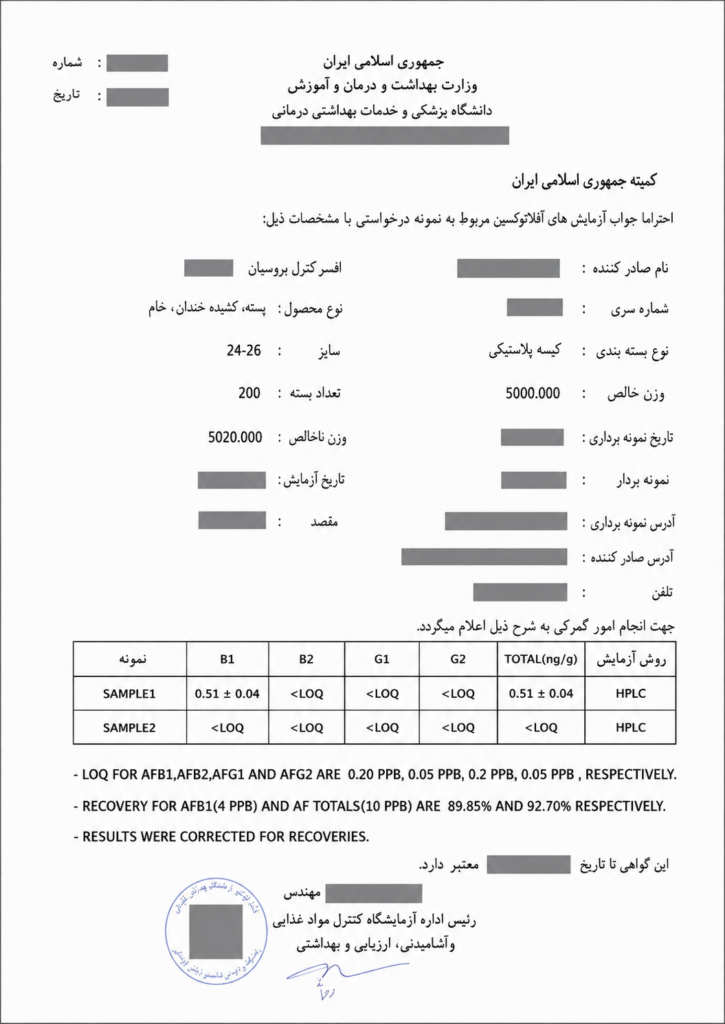
The example below is based on an official test report issued by an accredited Iranian food-control laboratory under the Ministry of Health, Treatment and Medical Education, for a shipment intended for the European market. Commercial and customer-identifying details have been redacted; analytical values, sample identification, and test method are shown as issued.
| Field | Detail |
| Product | Pistachio, long open (khandan), raw |
| Kernel size | 24–26 |
| Net weight | 5,000.000 kg |
| Sampling date | 1402/12/13 (03 March 2024) |
| Test date | 1402/12/14 (04 March 2024) |
| Destination | Denmark |
| Analytical method | HPLC |
Results (ng/g, equivalent to µg/kg):
| Sample | B1 | B2 | G1 | G2 | Total |
| Sample 1 | 0.51 ± 0.04 | < LOQ | < LOQ | < LOQ | 0.51 ± 0.04 |
| Sample 2 | < LOQ | < LOQ | < LOQ | < LOQ | < LOQ |
Limit of quantification (LOQ): AFB1 0.20 ppb, AFB2 0.05 ppb, AFG1 0.2 ppb, AFG2 0.05 ppb. Recovery rates: 89.85% for AFB1 (spiked at 4 ppb) and 92.70% for total aflatoxins (spiked at 10 ppb); results were corrected for recovery.
Both samples in this example fall well within the EU limit of 8 µg/kg AFB1 and 10 µg/kg total aflatoxins for pistachios intended for direct consumption.
A real laboratory report like this gives prospective buyers first-hand evidence of the type of analytical documentation available for a tested export product. It supports pre-shipment product assessment but does not replace official EU sampling, certification, CHED-D, or other border-control requirements where they apply.
Conclusion
Aflatoxin Management is not a “one size fits all” situation for European pistachio importers. Representative sampling is as important as the sophistication of the laboratory method employed, and the risk starts early in the supply chain, with splitting and physical damage, as well as post harvest handling, drying and storage. Even the most advanced test provides limited assurance if the sample submitted doesn’t represent the commercial lot.
That’s why the inclusion of aflatoxin in supplier approval and procurement and not solely in the process of customs preparation is necessary. As a buyer, it is important to understand which limit is applicable to your product, how the lot was sampled, which laboratory analysis was conducted, whether you can trace the report back to the product you are buying, and which import requirements are currently in place in the EU.
European buyers who have ordered pistachios from RTFS Nut can ask for the aflatoxin laboratory report documentation that comes with the product they have ordered for export, prior to shipment with the intention of providing them with documented analytical information to review along with origin, grade, commercial specification and applicable EU import requirements.
Frequently Asked Questions
Is there aflatoxin in pistachios?
Yes, aflatoxin can occur when toxin-producing fungi contaminate pistachios under suitable conditions. Not every pistachio or shipment exceeds legal limits representative sampling and laboratory testing determine the actual level.
Are pistachio nuts contaminated with aflatoxins?
Some are, particularly after early splitting, insect damage, poor drying, or improper storage. Contamination is not uniform, so laboratory testing of a representative sample is required.
Can sorting remove aflatoxin from pistachios?
Sorting reduces risk by removing visibly defective or damaged nuts, but it cannot confirm compliance with the aflatoxin limit — laboratory testing is still required.
Which aflatoxin testing method is best for pistachios?
No single method suits every purpose. ELISA is common for screening; HPLC and LC-MS/MS provide quantitative analysis. The right choice depends on testing purpose, sensitivity, and validation requirements.
What documents should an EU importer request from a pistachio supplier?
Typically: the laboratory aflatoxin results, lot or sample identification, product specification, a Certificate of Analysis, traceability records, and required official import documents.
Regulatory reference: Commission Implementing Regulation (EU) 2023/2782